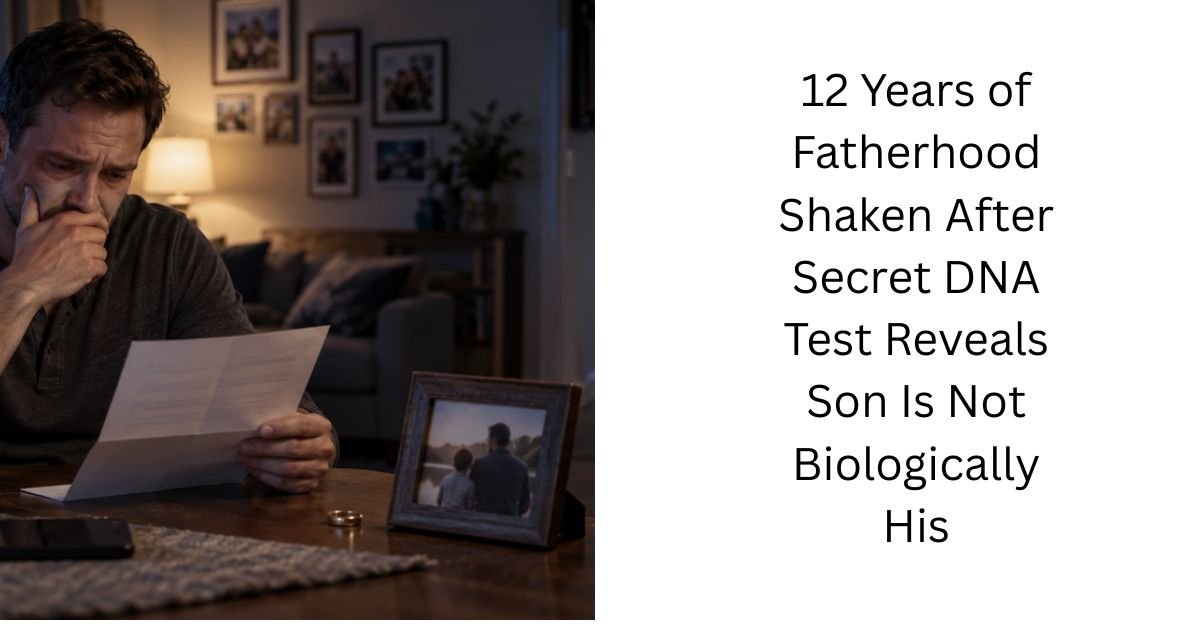
12 Years of Fatherhood Shaken After Secret DNA Test Reveals Son Is Not Biologically His
For twelve years, I believed I knew exactly what it meant to be a father. My son was there from the moment he was born, and I never once questioned whether he was mine. I was in the hospital when he came into the world, held him for the first time, and spent the next twelve years watching him grow into the person he is today. I changed diapers, stayed up during countless sleepless nights, attended school events, helped with homework, taught him how to ride a bike, and was there every time he needed someone. I never thought of him as anything other than my son. My wife and I had built what I believed was an ordinary family, with the usual arguments, financial struggles, vacations, birthdays, and difficult moments that every family experiences. Nothing prepared me for the discovery that would make me question a part of our family history I had never even thought to doubt.
The truth came to light because of something I never expected to become important: a private DNA test. I had been curious about my family ancestry and decided to take one of those home DNA tests that provide information about your genetic background and family connections. My son was interested in the idea too, so we eventually decided to do the test together. Neither of us expected anything unusual. We were mostly curious about where our ancestors might have come from and whether we would discover distant relatives. When the results arrived, however, I noticed something that immediately made me uncomfortable. The expected biological relationship between my son and me was not there. At first, I assumed there had been a technical mistake. I checked the information several times and even contacted the company because I could not believe what I was seeing. But after reviewing everything, the possibility became impossible to ignore. According to the results, I was not my son’s biological father.
I felt like the floor had disappeared beneath me. I kept thinking about the past twelve years and wondering how something like this could have happened without me knowing. My first reaction was not anger toward my son. It was confusion and disbelief. I started thinking about the period when my wife was pregnant, trying to remember whether there had been anything unusual about that time. I could not remember anything that would have made me suspicious. I had trusted my wife completely, and I had never questioned her about my son’s biological parentage because there had never been a reason. I also found myself looking at old photographs of my son and comparing his features to mine, something I had never done before. Suddenly, every small difference seemed significant. I hated that my mind was doing this because my son was still the same child I had loved for twelve years. Nothing about him had changed. The only thing that had changed was what I believed about his biological history.
Eventually, I confronted my wife. I did not know how to approach the conversation without completely losing control, so I showed her the results and asked her to explain. Her reaction told me almost immediately that this was not the simple laboratory mistake I had hoped it would be. She became extremely emotional and eventually admitted that there had been another man around the time our son was conceived. She insisted that she had never known for certain who the biological father was and said she had always assumed I was because we were married and together at the time. She apologized repeatedly and said she was terrified of what would happen if I discovered the truth. I asked her why she had never told me there was even a possibility. She said she had buried the memory because she wanted our family to remain together. But from my perspective, she had not protected our family by keeping the secret. She had simply taken away my ability to make an informed decision about my own life.
The hardest part was realizing that my son knew nothing about any of this. He still sees me as his father, and I still see him as my son. I have been the person taking him to school, attending parent meetings, helping him with difficult assignments, cheering from the sidelines, and listening to him talk about his friends and interests. We have twelve years of memories together that cannot be erased by a DNA result. At the same time, I am struggling with the fear that telling him the truth could completely change the way he sees himself and our family. He is old enough to understand what biological parentage means, but I do not know whether he is emotionally prepared to hear that the man he thought was his biological father is not actually related to him by blood. I also cannot stop thinking about whether he has a right to know who his biological father is.
I have considered contacting the biological father, assuming we can identify him, but even that decision feels overwhelming. I do not know whether he knows that my son might be his child, and I do not know whether bringing him into our lives would help or create even more confusion. My son deserves answers about his biological history, but I also worry about introducing a stranger into a family relationship that has existed for twelve years. As for my marriage, I honestly do not know what will happen. The DNA result itself did not cause all of this damage. The real problem is the secrecy and the fact that my wife knew there was a possibility that I was not the biological father but allowed me to live under a different assumption for more than a decade. I am struggling to decide whether trust can ever be rebuilt after something this significant.
For now, I have decided that I will not make any major decisions while I am still overwhelmed by anger and shock. My son is not responsible for any of this, and I refuse to let him feel as though he has done something wrong. Biology may determine genetics, but it does not erase twelve years of fatherhood. I am still his dad, regardless of what the DNA test says. I am the person who was there when he took his first steps, when he was sick, when he was scared, and when he needed someone to believe in him. I do not know what the future will look like, and I still have difficult conversations ahead with my wife and eventually my son. But one thing I know for certain is that a laboratory result cannot erase twelve years of love, memories, and responsibility. The biggest question I am facing now is not whether I can stop being his father, because I cannot imagine doing that. It is whether I can find a way to accept the truth without allowing someone else’s secret to destroy the relationship that means the most to me.
Read Story…
I (34m) conducted a paternity test behind my wife’s back on our 12 year old son.
Typing this out in Mobile. Apologies for grammar or formatting
A little back story before I get to the meat. My wife and I met when I was 20. We had a drunk hookup the first night we met. We continued seeing each other after that night. A few weeks later she found out she was pregnant. We stayed together and I proposed a few months later. I had doubts about her pregnancy lining up with our timeline but I never brought it up or discussed it. Not to mention I was in the military and deployed a few months later. My proposal weighed a lot on her carrying my child. I grew up in a home without a dad and never wanted that.
Fast forward 12 years we are still married. Though it has been extremely volatile and rocky I’ve stayed together honestly because I could never part from my son. I can’t let him grow up with an absent father. So I’ve made it work. Our marriage is dead outside of our child.
I ran into an old friend who I knew around the time I met my wife. He asked if I was still with her and I said yes. He mentioned how “it was crazy I dated her and then you stole her from me!” I wasn’t sure what he meant and asked him to elaborate. He said “it’s no big deal but I was seeing her up until that weekend you met her.” I dropped it but inside my doubt and insecurities ran wild. I couldn’t get it out of head. I broke down and bought a home DNA test kit and used it on my son and I without telling my wife.
The results came back today. He is not my son. 0% chance I am his biological son. I’m destroyed. My whole world is upside down. I’m just on autopilot at the moment. I don’t know how to act or feel. I’m just a zombie right now.
One thing I know is no matter what he is my son. I’ve been by his side the moment he was born and will absolutely never abandon him. Absolutely nothing will change that.
What I haven’t decided is how if at all I bring it up to my wife. I feel like my whole marriage was a lie. I can’t help but wonder if she knew. How do I confront her. Regardless that I’m not in love with her I still love her. This will crush her. This will absolutely devastate her. I don’t know what to do. I plan on seeing a counselor/therapist ASAP. So many emotions and thoughts flooding my mind. Just need some help to bring me back down.
EDIT: I appreciate all the support and words of advice. Both good, bad and the assholes. I’m going to sit on this until I get my head right.
Twelve Years of Unquestioned Fatherhood
For twelve years, I never questioned whether my son was really mine. From the day he was born, I considered myself his father in every possible sense. I was there during his mother’s pregnancy, waited anxiously at the hospital, and held him shortly after he was born. I remember how tiny he looked and how terrified I was about becoming responsible for another human being. I had no idea what I was doing, but I knew immediately that I loved him. Over the next twelve years, I built my entire life around being his dad. I changed diapers, prepared bottles, stayed awake when he was sick, attended school events, helped with homework, and celebrated every birthday with him. His biological connection to me was never something I thought about because I simply assumed it was a fact.
My wife and I were already married when our son was born, and at the time, I believed our marriage was strong. Like every couple, we had disagreements and stressful periods, but I never believed there was anything serious enough to make me question our family. When our son arrived, we were both excited about becoming parents. Our families celebrated with us, and my parents were especially happy to become grandparents. My son developed a close relationship with my parents, and I loved watching them spend time together. Looking back now, those memories are difficult because I know there was information about his biological history that I did not have.
The discovery happened in a way I never expected. I had always been somewhat interested in genealogy and family history, so I decided to take a consumer DNA test. My main goal was simply to learn more about my ancestry. I wanted to know where previous generations of my family had come from and whether I might discover relatives I had never heard of. My son became curious about it too, and eventually we decided that he would take a test as well. Neither of us thought there was anything unusual about doing it. It was supposed to be an interesting little project we could do together.
When the results came back, however, I immediately noticed something strange. The system did not identify the biological relationship between my son and me that I expected to see. At first, I assumed I had entered some information incorrectly. I checked both profiles and reviewed the results several times. I even wondered whether there could have been a laboratory error. There was no reason in my mind for the results to suggest that I was not his biological father. I had never questioned his paternity, so the possibility did not even exist in my mind before that moment.
I contacted the testing company because I was convinced something had gone wrong. I wanted another explanation before I even considered the possibility that the results were accurate. After reviewing the information, however, they confirmed that the results indicated we were not biologically related in the way a father and son should be. Reading that confirmation was one of the most surreal experiences of my life. I stared at the screen for a long time, unable to understand how the child I had raised for twelve years could supposedly not be biologically mine.
My first reaction was complete disbelief. I kept telling myself that there had to be another explanation. Maybe the sample had been mixed up. Maybe there was a technical problem. Maybe something about the test was being misunderstood. I searched through old memories trying to find some clue that would explain what I was seeing. But there was nothing. I had trusted my wife completely, and I had never once thought that our son could have another biological father.
Then the anger started.
I realized that there was really only one person who could explain what had happened.
My wife.
I waited until we were alone and showed her the results. I did not know how to begin the conversation, so I simply asked her whether there was anything about our son’s conception that I needed to know. The moment she saw the results, her expression changed. She became quiet, and I immediately knew there was more to the story than I had been told.
She eventually admitted that she had been involved with another man around the time our son was conceived.
Hearing those words was devastating.
I asked her whether she had known there was a possibility that I was not the biological father. She said she had always suspected it might be possible but had convinced herself that I was probably the father. According to her, the other relationship had happened during a difficult period in our marriage. She said she regretted it and had been afraid that telling me the truth would destroy our family.
I could not understand how she had been able to keep such an enormous secret for twelve years.
For twelve years, I had been raising a child while believing I knew the truth about his biological identity. I had made decisions about our family based on information that apparently was not complete. My wife had watched me proudly introduce him as my son, watched me care for him when he was sick, and watched me build my entire life around him. She knew there was a possibility that I was not his biological father and never told me.
That realization hurt almost as much as the affair itself.
I asked her who the biological father might be. She gave me a name, but that created another wave of questions. I had never met the man as far as I knew, and I had no idea whether he knew that a child might have resulted from their relationship. My wife said she had never told him because she had decided to remain with me and raise our son as part of our family.
I was furious that she had made that decision without giving me the truth.
She said she believed she had done it to protect everyone.
I told her that she had not protected me.
She had taken away my choice.
If I had known twelve years ago that there was a possibility I was not the biological father, I could have decided how I wanted to handle the situation. Maybe I would still have raised my son exactly as I did. Maybe I would have wanted a DNA test immediately. Maybe I would have wanted to meet the biological father. I do not know. But that decision should have belonged to me too.
The strange thing is that despite everything I was feeling, my son himself never became the target of my anger.
I looked at him and saw exactly the same kid I had seen the day before I received the DNA results. He still had the same laugh, the same habits, the same personality, and the same way of asking me questions when he wanted something. Nothing about him had changed. Only my understanding of his biological history had changed.
I started feeling guilty whenever I caught myself looking for differences between us.
Before the test, I had never cared whether he had my eyes, my nose, or my personality. I simply thought he was my son. Afterward, I found myself noticing every feature and wondering where it came from. I hated that the test had put those thoughts into my head. My son deserved better than to have his father’s love reduced to genetics.
At the same time, I could not pretend the DNA results did not matter.
There is a difference between being someone’s biological father and being the father who actually raised them, and I suddenly found myself caught between those two ideas. Biologically, I may not be his father. But emotionally, practically, and legally depending on the circumstances, I have been his father for twelve years.
I have been there for every important moment.
I remember teaching him how to ride a bicycle. I remember the first time he fell and scraped his knee, and how he tried to pretend he was not crying. I remember helping him build school projects at the kitchen table and staying up late because he had forgotten about an assignment. I remember cheering at his sports games even when he barely paid attention to the score. Those memories are real regardless of what the DNA test says.
My biggest concern now is whether my son should be told the truth.
Part of me believes that he has a right to know his biological history. Another part of me is terrified that learning the truth could destroy his sense of security. He is twelve years old, and I do not know how he would react to being told that the man he has always called Dad is not his biological father.
There is also the question of his biological father.
I do not know whether this man should be contacted immediately or whether we should wait. If he does not know about my son, suddenly appearing in his life could create another layer of confusion. If he does know, then I have even more questions about why nobody told me. I have not contacted him yet because I do not want to make an impulsive decision while I am still emotionally overwhelmed.
My wife keeps asking me what I am going to do about our marriage.
Honestly, I do not know.
The betrayal is enormous. It is not just that she had another relationship. It is that she kept the possibility of our son’s different biological identity secret for twelve years. Every year that passed gave her another opportunity to tell me, and every year she chose silence.
She says she is sorry.
She says she loves me.
She says she was terrified of losing our family.
I believe that she may genuinely regret what happened, but regret does not automatically repair trust. Right now, I do not know how I could believe anything she tells me without wondering what else she might be hiding.
I have also had to deal with my own anger toward myself.
I keep asking myself how I could have missed something so significant. I wonder whether there were signs I ignored or whether I was simply trusting the person I had every reason to trust. I know rationally that I should not blame myself for someone else’s dishonesty, but emotions do not always follow logic.
For now, I am trying to focus on my son.
He has not changed.
He still needs his dad.
He still deserves the same support, love, and stability he had before the test results arrived.
I refuse to make him feel responsible for a situation he had absolutely no part in creating. Whatever happens between my wife and me, I want him to know that he is loved. If we eventually decide that he needs to know the truth, I want that conversation to happen carefully and with professional guidance rather than during an emotional argument.
I am also considering getting a more definitive paternity test before making any permanent decisions. The consumer test gave me information I never expected, but I want certainty before changing anyone’s life based on it. I need to know exactly what the biological relationship is before I decide what comes next.
The hardest thing to accept is that I cannot go back to the morning before I opened those results.
Before that day, I had a simple story about my family. I was married, I had a son, and I was his father. Now that story has been complicated by a secret that existed for twelve years without my knowledge.
But there is one part of that story that has not changed.
I am still the man who raised him.
I am still the person who was there when he needed someone.
And I am still his dad.
Maybe biology will change part of how I understand our family, but it cannot erase twelve years of love and memories. I do not know whether my marriage will survive this, whether I will ever forgive my wife, or whether my son will eventually meet his biological father. Those are questions I will have to face one at a time.
For now, I am trying to remind myself that my son did not become less mine because of a laboratory result. The truth may change our family history, but it does not have to change the relationship we have built together. I spent twelve years being his father without ever needing DNA to prove it, and I do not want one test to make me forget everything those twelve years actually mean.