Family Debates If Tipping Is Still Mandatory After Restaurant Refuses Delivery
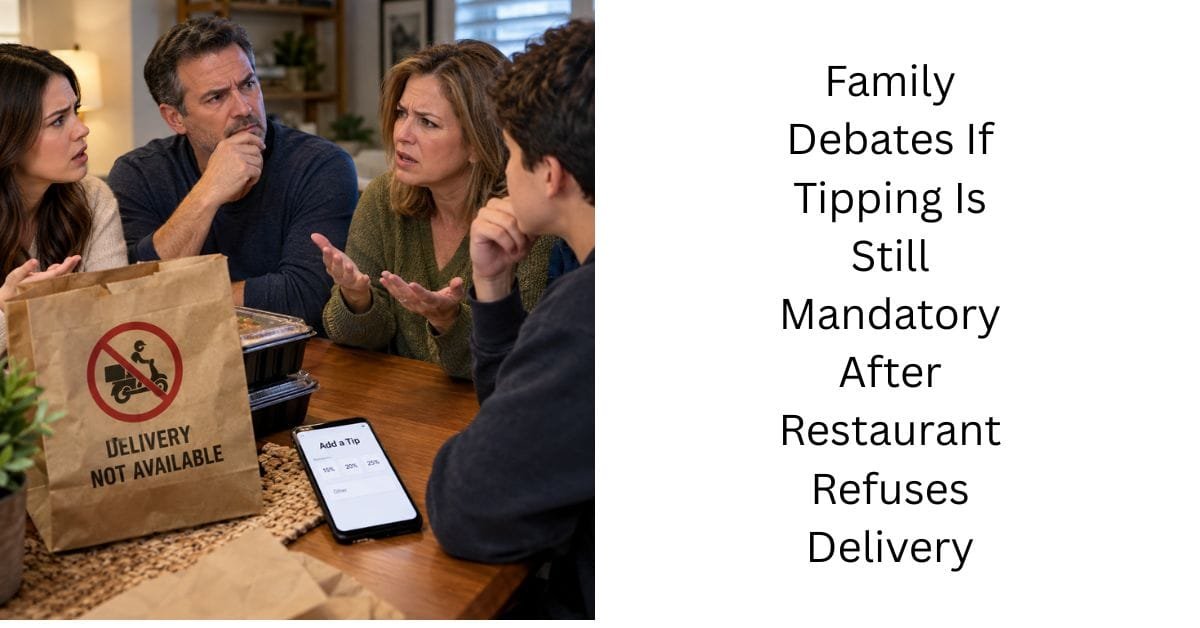
This happened about two hours ago, and honestly, I still can’t decide whether I was being unreasonable or whether the restaurant’s behavior completely changed the situation. My family was trying to decide what we wanted for dinner, and after going back and forth for a while, we agreed to order takeout. Everyone was hungry, nobody wanted to cook, and we figured ordering food would be the easiest option. We picked a restaurant that we had ordered from before and placed an order that was large enough for everyone. Since none of us particularly wanted to leave the house, we asked if the restaurant could deliver the food. We were told that delivery would be available, so we confirmed the order and waited. At that point, everything seemed completely normal, and nobody was thinking about the tip.
A little while later, we received a call from the restaurant saying there was an issue with the delivery. Apparently, they were short on drivers and couldn’t send someone to our address after all. We asked whether we could simply pick up the food ourselves, and they said that was fine. Since we had already placed the order, someone in my family volunteered to drive over and collect it. It wasn’t a huge inconvenience, but it did mean that the entire reason we had chosen delivery in the first place was gone. We had expected to pay for the convenience of having the food brought to our door, but now we were going to have to spend time and fuel picking it up ourselves. Nobody was furious about that part. Things happen, and we understood that restaurants can have staffing problems.
The disagreement started when we looked at the total and realized that the order still included the delivery-related charge. We called the restaurant back and asked whether that fee could be removed since they were no longer providing delivery. The person on the phone said they could remove the delivery charge, which seemed reasonable. Then, however, the conversation shifted toward the tip. We had initially included a tip when placing the order because we assumed a delivery driver would be bringing the food to us. Once we were told that there would be no delivery and that we had to collect the food ourselves, one member of my family suggested that we should remove or reduce the tip. Another family member immediately disagreed and said that the restaurant workers still deserved to be tipped because they had prepared the food.
That started a surprisingly serious debate at the dinner table. One side argued that tipping is supposed to reflect service, and the service we had originally agreed to pay for was delivery. If there was no delivery, they felt the tip should at least be reconsidered. Their argument wasn’t that restaurant employees didn’t deserve tips. They simply believed that the circumstances had changed. If someone orders a meal for delivery and tips the driver, but the restaurant later says there is no driver and the customer has to pick the food up, it seems reasonable to ask whether the original tip still makes sense. The other side argued that the kitchen staff had still prepared the entire order and that tips have become part of the expected compensation in the restaurant industry. They felt that removing the tip just because the restaurant couldn’t deliver would unfairly punish workers who had nothing to do with the delivery problem.
I could see both sides, which was what made the conversation so frustrating. If we had received the delivery exactly as promised, I wouldn’t have questioned the tip at all. I would have considered it part of the cost of having someone bring our food to the house. But once the restaurant told us that we had to drive there ourselves, I wasn’t sure whether the same expectation applied. We weren’t asking for free food or refusing to pay the restaurant. We were simply questioning whether a tip that had been calculated around a particular service should remain unchanged after that service disappeared. One family member said that tipping has become so automatic that people are afraid to question it even when the circumstances clearly change.
Another family member thought that attitude was unfair. They argued that the people preparing the food don’t control whether the restaurant has enough delivery drivers. The cooks still had to prepare every item, package it, and make sure the order was ready. From that perspective, removing the tip could send the wrong message to workers who had done their part correctly. They also pointed out that the restaurant might distribute tips among multiple employees rather than giving everything to a delivery driver. We didn’t actually know how this particular restaurant handled tips, so that made the situation even less clear. We were basically debating a system without knowing exactly where the money would go.
At one point, someone suggested that we should simply pick up the food, leave the original tip, and never order from that restaurant again. That would have ended the argument, but another family member felt that was unnecessary. They said the restaurant had already removed the delivery charge, so perhaps leaving the tip was the polite thing to do. I understood that perspective too. The restaurant hadn’t intentionally refused to deliver our food. They said they were short-staffed, and staffing problems aren’t always something employees can control. We also weren’t dealing with rude behavior or terrible food. The only thing that had changed was that we were no longer receiving the delivery service we had expected.
What bothered me most was how quickly the conversation became less about this specific order and more about tipping in general. Everyone had a different opinion about whether tipping should be mandatory, expected, optional, or based entirely on service. One person argued that businesses should simply pay employees better and stop making customers responsible for wages. Another said that until the industry changes, refusing to tip doesn’t solve the problem and only hurts workers. Someone else said customers shouldn’t be expected to tip the same amount regardless of whether they receive excellent service, average service, or no delivery service at all. By the end, we weren’t even really discussing our dinner anymore. We were debating the entire tipping culture.
Eventually, we decided that we would pick up the food ourselves and leave a smaller tip rather than the amount we originally planned for delivery. Nobody was completely satisfied with that decision, but it seemed like the most reasonable compromise. We weren’t trying to punish the restaurant workers, and we weren’t pretending that preparing the order required no effort. At the same time, we felt that the final service we received was different from the service we had originally agreed to pay for. I still don’t know whether reducing the tip was the right decision, and that’s probably why the whole thing has stayed on my mind. Maybe tipping should be based on the service actually provided rather than the service originally expected. Or maybe restaurant workers shouldn’t lose out when a delivery problem is caused by circumstances beyond their control. Either way, what started as a simple family dinner order somehow turned into a full debate about whether tipping is truly optional anymore.
Read Story…
AITA I didn’t tip for picking up an order.
This happened about two hours ago. My family was deciding what they wanted for dinner and we agreed to get take out.
We have a local tavern that does delivery and they got pretty good food. The problem is the last two weeks we tried to get delivery, they said they weren’t doing delivery that day.
This happens some time with most places in our area and with the current state of the country, I tend to understand.
I called tonight for delivery and once again they said they weren’t offering delivery tonight.
I explained that the last couple of weeks, we were told no delivery when we called, the website, their menu and their Facebook page all still advertise it. I wanted to know if this was just bad timing or if they just stopped offering delivery.
The person on the phone suddenly got huffy with me and said the only person who could deliver was the cook and they were really busy.
The family really wanted food from this place, so I just sucked it up, had someone else place the order and went and picked it up myself.
When I got back they asked me if I tipped them or not. I told them that the cook gets a regular wage and I had to get the food myself, I wasn’t going to tip the bartender for literally handing me a bag.
Now my family is split, half of them agee with me, half of them say I’m the asshole. I don’t see why I should tip someone who had almost no part of my transaction.
Family Dinner Order Turns Into a Heated Debate Over Tipping and Unreceived Service
This happened about two hours ago, and I’m still laughing a little at how quickly a simple dinner decision turned into a family debate about tipping, customer service, and whether people are expected to pay for services they never actually receive. My family was trying to figure out what we wanted for dinner, and after everyone rejected several suggestions, we finally agreed to order takeout. Nobody wanted to cook, and nobody particularly wanted to leave the house either. We decided to order from a restaurant we had used before because everyone could find something they liked on the menu. It seemed like an easy decision, and at the time, I had no idea that a dinner order would somehow become a disagreement that lasted almost the entire evening.
Advertisement
We placed the order and requested delivery because the whole point of ordering food was to avoid having someone drive across town. The restaurant accepted the order without any problem, and we were given an estimated delivery time. When we placed the order, we included a tip because we assumed a delivery driver would be bringing the food to our door. Nobody in the family complained about tipping at that point. We have always understood that delivery drivers spend their own time and fuel getting food from restaurants to customers, so we normally consider a tip part of the cost of ordering delivery. As far as we were concerned, everything was settled. We were going to pay for the food, the delivery fee, and the tip, and then enjoy dinner.
A little while later, the restaurant called us. The person on the phone apologized and explained that they had unexpectedly run into a staffing problem. They didn’t have a driver available to deliver our order. We asked whether that meant the order would be canceled, but they said the food could still be prepared and picked up. Since everyone was already hungry and the order had been placed, we agreed to send someone to collect it. It wasn’t ideal, but we understood that businesses sometimes have unexpected problems. We weren’t going to demand that someone magically appear just because we wanted our dinner delivered.
The person who went to pick up the food was already planning to leave the house for another reason, so the inconvenience wasn’t enormous. However, we did have to adjust our plans. More importantly, the service we had originally requested was no longer being provided. We had ordered delivery specifically because we didn’t want to make the trip ourselves. Once the restaurant told us there was no driver, the main reason for paying for delivery disappeared. We weren’t particularly angry about it, but we did think the final bill should reflect what we actually received.
Before leaving, we called the restaurant again to make sure there wouldn’t be confusion when the order was picked up. We explained that we had originally paid for delivery but were now being asked to collect the order ourselves. The restaurant agreed to remove the delivery charge, which seemed completely fair. We thanked them and thought the issue was finished. Then someone asked about the tip. That was when the discussion started.
When we originally placed the order, we had added a tip because we expected a delivery driver to bring everything to our home. Once delivery was canceled, one family member said we should remove the tip entirely. Their argument was straightforward: if the tip was intended for the person delivering the food, there was no delivery person anymore. Another family member disagreed immediately and said the tip should stay because the restaurant employees still had to prepare the order. Suddenly everyone had an opinion.
I understood the argument for removing it. If I pay extra because someone is providing a specific service, and that service doesn’t happen, it feels strange to automatically pay the same amount anyway. Imagine ordering a ride and paying a gratuity because someone is driving you home, only to be told you have to walk there yourself. You might still appreciate the company, but the original reason for the tip has changed. That’s essentially how one side of our family viewed the restaurant situation.
The other side saw it differently. They argued that the tip wasn’t necessarily going to a delivery driver in the first place. Depending on the restaurant’s system, it might be shared among kitchen staff, servers, or other employees. The people working in the restaurant still had to prepare the meal, package everything correctly, and have the order ready on time. From their perspective, those employees shouldn’t lose out simply because the restaurant couldn’t find a driver.
That led to the obvious question: who was the tip actually for?
None of us knew.
We realized that we had been tipping automatically without really understanding how that particular restaurant distributed tips. Some people assumed it went to the driver. Others thought it was shared. Someone pointed out that if we were ordering takeout for pickup, tipping might still be expected even though there would be no delivery driver at all. That made the whole situation even more confusing because we were now questioning whether the original tip was actually connected to delivery.
The conversation quickly became a much bigger argument about tipping culture. One family member said they hated how tipping seemed to be expected everywhere now. They said customers were increasingly being asked to tip before receiving their food or service, sometimes without even knowing whether the service would be good. They argued that tipping should be optional and based on the quality of service rather than treated like an additional mandatory fee.
Another family member strongly disagreed. They said restaurant workers depend on tips and that customers should understand the system before deciding not to participate. They pointed out that workers often don’t control their wages or staffing levels. If the restaurant doesn’t have enough drivers, that’s a management problem, not something the kitchen employee caused. From that perspective, reducing the tip because of a staffing issue seemed unfair.
Someone else brought up the fact that we weren’t actually complaining about the food or the employees. If the food was prepared properly and ready when we arrived, the kitchen staff had done their job. The only failure was the delivery service. That made the question more specific: should the tip be reduced because one part of the service failed even if the rest of the order was handled correctly?
We went back and forth for quite a while.
I personally thought there was a reasonable argument on both sides. If a restaurant promises delivery and then can’t provide it, I don’t think a customer is unreasonable for reconsidering a delivery-related tip. At the same time, I don’t think the employees preparing the food should automatically be punished for something outside their control. The restaurant’s staffing issue wasn’t necessarily the fault of the person cooking our food or packaging the order.
The person who was going to pick up the food suggested a compromise. Instead of completely removing the tip, we could reduce it. That way, we would still leave something for the restaurant workers while acknowledging that we didn’t receive the full service we originally expected. Some people thought that was fair. Others argued that it made no sense because a tip isn’t supposed to be a penalty based on whether a restaurant has enough employees.
Then someone asked a different question: what if we had never tipped in the first place?
That opened another debate.
Some people said they would never have tipped for pickup because they believe tips should primarily go toward table service or delivery. Others said they almost always tip because restaurant workers aren’t paid enough and they would rather contribute something than leave nothing. One person admitted that they sometimes feel pressured to tip even when they don’t really want to because the payment screen makes the options so visible.
That observation started a conversation about how tipping has changed over the years. People used to associate tipping primarily with restaurants, taxis, and delivery. Now, customers can be asked to tip at coffee shops, takeout counters, stores, and other places where tipping wasn’t traditionally expected. One family member said they felt guilty every time they saw a tip screen, even when they couldn’t understand why they were being asked to tip.
Another person said that guilt shouldn’t be part of the system. If tipping is truly optional, customers should be able to say no without feeling like they are insulting the employee. If businesses depend on tips to make their workers’ wages reasonable, then perhaps the business model itself needs to change. That led us into an entirely separate discussion about wages, prices, and whether restaurants should simply charge more for food and pay employees better.
Meanwhile, the food was sitting there waiting to be picked up.
Eventually, we had to make an actual decision. The person driving to the restaurant asked what we wanted them to do about the tip. Nobody could agree completely, so we settled on leaving a smaller tip than we had originally planned. The restaurant had already removed the delivery charge, and we decided that reducing the tip slightly seemed like a reasonable middle ground.
Nobody was trying to punish the employees.
We also weren’t trying to make some grand statement about tipping culture.
We simply didn’t feel comfortable paying the exact same amount for a service that had changed significantly. If we had received the delivery we originally requested, we would have happily paid the original tip. Since we had to pick up the food ourselves, we felt it was reasonable to reconsider the amount.
The person who picked up the food said the restaurant employees were polite and didn’t seem upset about the change. That actually made me feel better because I didn’t want anyone at the restaurant thinking we were angry at them personally. The staff hadn’t created the shortage of drivers, and we understood that. The situation was inconvenient, but it wasn’t some terrible customer-service experience.
After dinner finally arrived, the debate continued for another few minutes. Someone joked that we had spent more time arguing about the tip than we had spent deciding what food to order. That was probably true. What started as a simple question about whether to leave a gratuity turned into a discussion about restaurant wages, customer expectations, staffing problems, and the strange pressure surrounding tipping.
Looking back, I think the most interesting part is that there doesn’t seem to be one universally correct answer. If a customer orders delivery and the restaurant can’t provide it, I can understand why the customer would reconsider a delivery-related tip. But I can also understand why someone would want to leave a tip anyway because restaurant employees still did work to prepare the order. The answer might depend on where the tip goes, what the restaurant’s policy is, and what service was actually provided.
For our family, the final decision was to leave a reduced tip and move on. Nobody was completely satisfied with that answer, but it seemed fairer than either extreme. We weren’t going to pretend that delivery had happened when it hadn’t, but we also didn’t want the kitchen staff to receive nothing because the restaurant couldn’t find a driver. In the end, the food was good, the restaurant removed the charge we weren’t supposed to pay, and everyone eventually ate dinner.
Still, I can’t help wondering what other people would have done. Would you leave the original tip because the restaurant employees still prepared the food? Would you reduce it because the delivery service was canceled? Or would you remove it completely because you had to pick up the order yourself? I started the evening thinking we were simply ordering dinner, and somehow we ended up having a full family debate about whether tipping is actually optional anymore. Maybe that’s the real issue: nobody seems to agree on what a tip is supposed to represent in the first place.