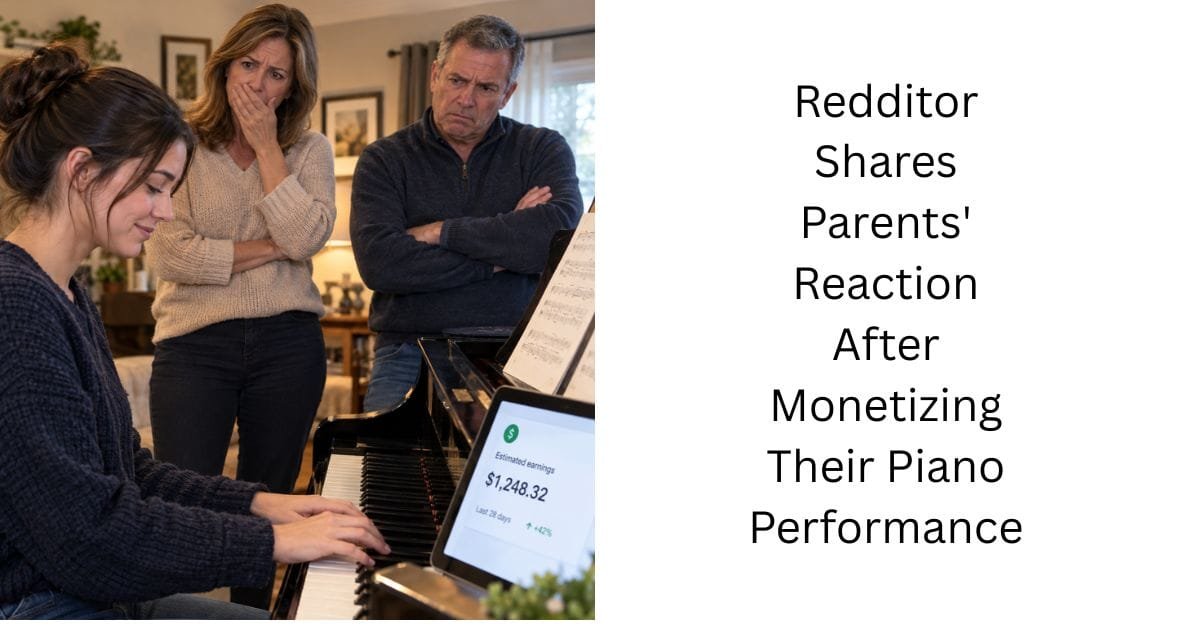
Redditor Shares Parents’ Reaction After Monetizing Their Piano Performance
Before the world went to shit, my parents absolutely loved hosting big parties at our house. They enjoyed having relatives, friends, coworkers, neighbors, and sometimes people I barely knew filling the house with conversations, food, music, and laughter. Whenever they hosted one of these events, they would usually ask me to play the piano for everyone. I didn’t mind doing it at first because I’ve been playing piano since I was five years old, and music has always been a huge part of my life. I have competed at both state and national levels, spent countless hours practicing, and reached a point where playing piano wasn’t just something I did for fun. It was a serious skill that required years of discipline and commitment. Because these were family parties, I usually played without expecting anything in return.
For years, my parents treated my performances as one of the special features of their parties. They would tell guests that their child was going to play piano and sometimes even request specific songs from me. I usually went along with it because I loved making people happy and I knew my parents were proud of me. However, as I got older, I started realizing that there was a difference between casually playing for family and performing for a room full of people who were specifically there to listen to me. These weren’t five-minute performances where I sat down and played one song. Sometimes I would spend hours practicing beforehand, choosing appropriate pieces, and then playing for a significant portion of the evening. Still, because it was my parents’ house and their party, I never thought much about asking for compensation.
Things changed when the pandemic happened and the big parties stopped. Suddenly, the gatherings, dinners, celebrations, and events that my parents had always enjoyed disappeared. Like a lot of people, we had to adjust to a completely different routine. I also had more time to think about what I wanted to do with my piano skills. I realized that I had spent years developing something that could potentially be valuable outside of family gatherings. I started looking into different ways musicians could earn money from performances, including online performances, recordings, private events, and other opportunities. The more I researched, the more I realized that my parents had been getting a fairly professional-level performance from me for free simply because I was their child.
Eventually, I decided that if my parents wanted me to provide an actual performance for one of their future parties, I would start treating it like a performance rather than a family favor. I wasn’t saying I would never play piano for them again. I wasn’t suddenly demanding money every time I touched the piano. My idea was that if they wanted me to prepare a specific set, practice for hours, dress appropriately, perform for their guests, and entertain everyone throughout the event, then I should be allowed to charge something reasonable. I figured it was no different from hiring a musician for a private party. The only difference was that the musician happened to be their child.
When I mentioned the idea to my parents, their reaction was much more negative than I expected. My mother laughed at first because she thought I was joking. When I explained that I was serious, she asked me why I would ever charge my own family to play piano at their house. I told her that I wasn’t charging them simply because they were my parents. I was charging for the time, preparation, and performance they were requesting. My father seemed equally confused and said that playing piano at family gatherings had always been something I did because I enjoyed it. I reminded them that I did enjoy playing, but enjoying something doesn’t automatically mean I should provide it as free entertainment whenever someone asks.
The conversation became more uncomfortable when my parents started talking about how talented I was and how proud they had always been of me. They said they had supported my piano lessons, competitions, equipment, and years of training, and they felt that asking them for money now was disrespectful. I understood their point to some extent. They had definitely invested in my development, and I was grateful for that. But I also felt that their support didn’t mean they automatically owned the results of all those years of work. I had spent thousands of hours practicing. I had competed at serious levels. I had sacrificed weekends and free time for rehearsals and competitions. None of that disappeared simply because my parents had paid for some of my lessons when I was younger.
I also pointed out something that seemed obvious to me: if they hired another pianist to perform the exact same pieces for the exact same amount of time, they would expect to pay that person. They wouldn’t tell a professional musician that because the musician enjoyed playing piano, the performance should be free. They wouldn’t expect a caterer to provide food for free just because cooking was their passion. They wouldn’t ask a photographer to spend several hours at the party without compensation simply because photography was their hobby. My parents argued that those people were professionals and I was family. That was when I told them that being family doesn’t make my time worthless. If anything, I thought family should understand and respect the effort involved.
My parents eventually told me that they might simply stop asking me to play. I told them that was completely fine. I wasn’t trying to force them to hire me. If they didn’t want to pay for a performance, they could hire someone else, play recorded music, or simply have a party without live piano. I wasn’t going to guilt them into paying me. At the same time, I didn’t think they had the right to guilt me into performing for free. That seemed to be the part they struggled with. They were used to me automatically saying yes whenever they asked, so the idea that I could now set a boundary surprised them.
Since then, the situation has been somewhat awkward. My parents still occasionally talk about hosting another big party, and whenever the subject of music comes up, there is an obvious silence. I haven’t brought up the money again because I don’t want every family gathering to turn into an argument. At the same time, I’ve started taking my piano career more seriously and exploring ways to monetize my performances. I don’t regret telling my parents that my time and skill have value. I still love playing for people, and I would happily perform for my family on certain occasions simply because I wanted to. But I don’t think agreeing to a free family performance once means I have permanently volunteered to be the entertainment at every party they ever host. Maybe my parents will eventually understand that I’m not trying to turn family into a business. I just want them to recognize that years of practice, preparation, and performance are worth something, even when the person performing happens to be their child.
Read Story…
AITA for “embarrassing” my parents by putting out a tip jar?
Before the world went to shit, my parents LOVED hosting big parties. They’d ask me to play piano during these parties, and I’d usually oblige. I’ve been playing piano since I was 5 and have competed at the state and national levels.
They recently resumed hosting parties now that a lot of their friends have been vaccinated. Usually, I come downstairs, play a few Liszt/Chopin pieces, and head back upstairs to my room because there’s no one my age at these parties. Before the most recent party, I got the idea of putting out a tip jar with a sign saying “pianoboy12345’s college fund” along with my cashapp, venmo, and paypal. I did this because I’m going to college in the fall and want some extra spending money. My parents are pretty well off and most of their friends are also well off, so I ended up earning almost $1000 that night.
My mom came up to me after the party was over and said I embarrassed her and my dad because the sign suggested that they’re going to have trouble paying for my college.
~~~~~~~~~~~~~~~~~~~~~~~~~~
Well, I had a talk with my parents and they said I should’ve 1. ran the tip jar idea by them first and 2. changed the wording on the sign (TY to all the commenters who left suggestions). They’re not going to cut me off as some have suggested. And for those who told me to get a real job, I’ll be teaching the 8 year old son of one of the party guests.
Talented Pianist Questions Parents’ Expectation of Free Performances
Before the world went to shit, my parents absolutely loved hosting huge parties at our house. They enjoyed having a full house, inviting relatives, friends, neighbors, coworkers, and people I sometimes barely knew. Their parties were usually elaborate affairs with plenty of food, drinks, decorations, and entertainment. One of the things they especially liked was having live piano music. Since I had been playing piano since I was five years old, they naturally turned to me whenever they wanted music for one of their gatherings. At first, I was completely fine with it. I loved playing, my parents were proud of me, and it felt good when guests complimented my abilities. I never expected money because I considered it something I was doing for my family.

Advertisement
I’ve been playing piano for most of my life, so performing isn’t just some casual hobby I picked up recently. I started when I was five and eventually became serious enough to compete at state and national levels. That required years of lessons, practice, rehearsals, competitions, and sacrifices. There were countless evenings when other kids were playing outside or relaxing while I was sitting at the piano practicing the same difficult section over and over again. There were weekends spent traveling to competitions and preparing pieces until I could play them almost perfectly. I don’t regret any of it because music became a major part of who I am. Still, I think my parents sometimes forgot just how much work went into developing that ability.
Whenever they hosted a party, my parents would casually tell guests that I would be playing piano. Sometimes they would ask me to prepare certain songs. Other times they would simply tell me to play for a couple of hours and keep the atmosphere lively. I usually agreed without complaining. There were nights when I played much longer than I originally intended because guests kept asking for another song. My parents would stand nearby smiling while people complimented me, and I admit that I enjoyed the attention. Hearing someone say that they had never heard a young pianist play that well was incredibly encouraging. At that point, I didn’t think about whether I was technically working or volunteering. I was just happy that people appreciated something I loved.
My parents also benefited from having me perform. They could tell their guests that their child was a highly accomplished pianist, and I became one of the attractions of their parties. People would gather around the piano, ask about competitions, and compliment my parents for raising someone so talented. My parents clearly enjoyed those conversations. Again, I didn’t mind. I actually liked seeing how proud they were. There was something satisfying about knowing that all those years of practice had become something my family could celebrate. The problem was that over time, the line between doing something nice for my family and providing free entertainment for their events became increasingly blurry.
Then the pandemic happened, and everything changed. The parties stopped almost overnight. My parents couldn’t host large gatherings anymore, and for a long time there were no dinners, celebrations, or events where they could ask me to perform. I also had fewer opportunities to play for other people. Like many people during that period, I spent a lot of time thinking about my future and what I wanted to do with my skills. I started wondering whether I could turn piano into more than just something I did for competitions and family events. That was when I began researching different ways musicians make money from their talents.
I discovered that there were actually many options. Musicians could perform at weddings, private parties, restaurants, corporate events, ceremonies, and other gatherings. Some recorded music, some taught lessons, and others performed online. The more I learned, the more I realized that my parents had been receiving something that could have significant monetary value without paying anything for it. That wasn’t necessarily their fault because I had always volunteered. But I began thinking that if I continued performing publicly, I should at least consider setting some boundaries around when I was willing to do it for free and when I expected compensation.
The first time I seriously thought about charging my parents, I actually felt a little ridiculous. They were my parents, after all. It felt strange to imagine sending them a price for playing piano at their own house. But then I thought about everything that went into one of their parties. If they hired a professional pianist, that person would need to prepare a set list, travel to the location, dress appropriately, perform for several hours, and potentially take requests. I was doing essentially the same thing. The only difference was that I happened to be their child. I started wondering whether being related to someone should automatically mean their professional-level skills have no value.
Eventually, my parents started talking about hosting another large party once things were more normal. They mentioned having live music again, and my mother immediately looked at me as though she expected me to understand what that meant. She said something along the lines of, “You’ll play for us again, right?” I didn’t immediately say yes. Instead, I told her that I was willing to discuss it, but if they wanted me to perform an actual set for several hours, I wanted to be paid. I tried to say it casually because I didn’t want to make it sound like a confrontation. Unfortunately, they didn’t take it casually at all.
My mother laughed and asked whether I was serious. I told her I was. She assumed I was joking because I had never charged them before. When she realized I wasn’t joking, she asked why I suddenly wanted money for something I had always enjoyed doing. I explained that I still enjoyed playing piano, but enjoyment didn’t mean that my time and skill were worthless. I wasn’t asking them to pay me every time I played something casually at home. I was talking specifically about formal performances where I would be expected to prepare and entertain their guests for a significant amount of time.
My father reacted similarly. He said that I was making family relationships unnecessarily transactional. He reminded me that they had paid for many of my piano lessons when I was younger. They had bought or helped pay for equipment, supported my competitions, driven me to events, and spent a lot of money helping me develop my skills. He felt that asking them for payment now was almost like charging them for something they had helped me achieve. I understood why he felt that way, but I didn’t think the conclusion followed. Their support had helped me develop my abilities, but it didn’t mean they were entitled to unlimited free performances forever.
I told them that I was grateful for everything they had done. I wasn’t trying to rewrite my childhood or pretend they hadn’t supported me. In fact, their support was one of the reasons I had been able to become as good as I was. But I had also spent years putting in my own effort. They couldn’t practice for me. They couldn’t compete for me. They couldn’t memorize difficult pieces for me. The actual skill belonged to me. I didn’t think appreciating their support required me to give away my time indefinitely.
My parents argued that I was their child first and a pianist second. I told them that I agreed, but that didn’t answer the question. If they wanted me to play casually for a family gathering, I would probably do it for free. If Grandma had a birthday and wanted me to play a few songs, I wouldn’t send her an invoice. If my parents had a small dinner and asked me to play something while everyone talked, I wouldn’t care about money. My issue was when they expected me to prepare a professional-style performance specifically for their guests. That felt different to me.
I gave them an example. I asked whether they would expect a professional photographer in the family to photograph one of their parties for several hours without compensation simply because they were related. My mother said that would be different. I asked why. She couldn’t immediately give me an answer. I explained that the photographer would be using a skill they had spent years developing, just like I was using mine. The same could apply to a family member who was a caterer, DJ, musician, designer, or any other professional. Being related might justify a discount or a favor sometimes, but it shouldn’t automatically erase the value of the work.
That comparison didn’t go over particularly well. My father said I was treating my own parents like customers. I told him I wasn’t. I was simply setting a boundary. They were free to ask me to play, and I was free to say no or give them a price. They were also free to decline and hire someone else. Nobody was being forced into anything. I thought that was a pretty straightforward arrangement, but they seemed to view it as a personal rejection.
My mother then asked how much I intended to charge. I gave her a reasonable number based on the amount of preparation and performance time involved. I wasn’t trying to charge some outrageous celebrity fee. I had looked at what musicians typically charge for private performances and tried to stay reasonable. My parents acted shocked anyway. They said they could hire another musician for that amount, and I responded that they absolutely could. I told them that if they preferred someone else, there were no hard feelings.
That answer seemed to confuse them even more. I think they expected me to argue or eventually give in. Instead, I genuinely meant it. I wasn’t demanding that they hire me. I was saying that if they wanted my performance, this was what I considered fair compensation. If they didn’t want to pay it, they could find another option. I wasn’t going to beg them to choose me. My goal was to make them understand that my time had value, not to force them into paying me.
They eventually brought up the fact that I had always been happy to perform before. I reminded them that circumstances change. When I was younger, I enjoyed playing for family because it felt like a fun part of the party. As I got older and became more serious about music, I began seeing performances differently. I had spent years building a skill that could potentially become a source of income. It seemed strange to me that everyone else could recognize that skill as valuable except the people closest to me.
There was also a practical issue. Performing for a large party wasn’t simply a matter of sitting at the piano and improvising. If they wanted specific pieces, I had to prepare them. If they wanted me to play for several hours, I had to plan the music carefully so I wasn’t repeating the same things. I had to make sure the pieces were appropriate for the audience and maintain enough energy to continue performing. Depending on the event, I might also have to arrive early, dress differently, and spend time preparing the piano. All of that was time that could otherwise be spent practicing for competitions, working, or doing something else.
My parents didn’t seem to understand that distinction. To them, I was simply their child sitting at a piano. They didn’t see the hours before the event when I might be practicing a difficult piece. They didn’t see the preparation involved in learning requests. They mostly saw the final performance. That’s understandable from their perspective, but it didn’t mean the preparation didn’t exist. A good performance often looks effortless precisely because the performer has already put in so much work.
Eventually, my father said that if I wanted to turn piano into a business, that was my choice, but he didn’t think I should bring money into family events. I told him that was fine. I wasn’t planning to charge them for every little thing. But if they wanted to use me as the entertainment for a large event, I wanted the option to treat that as paid work. I also told them I would still occasionally perform for family for free because I wanted to. I just didn’t want the assumption that my availability was automatic.
That distinction became important because I didn’t want them to think I had suddenly become obsessed with money. I wasn’t. There are some things I would gladly do for family without compensation. If someone asked me to play a song at a birthday dinner, I would probably say yes. If my parents wanted me to play a few pieces during a holiday gathering, I might even volunteer. What I didn’t want was to spend hours preparing and performing for a huge guest list while everyone assumed I was obligated to do it because I happened to be their son or daughter.
After the conversation, things became awkward for a while. My parents didn’t directly ask me to perform again. They started looking into other entertainment options for their next party. I heard them discussing hiring someone, and I didn’t interfere. Honestly, I was relieved. It meant I didn’t have to keep defending my position. They could make their own choice, and I could focus on my own music.
Interestingly, some relatives heard about the disagreement and had opinions of their own. A few thought my parents were being unreasonable. They said that if I had reached a competitive level on piano, it made sense for me to charge for professional performances. Others thought I was being too focused on money and should simply do it as a favor. I didn’t find either extreme particularly helpful. I wasn’t trying to monetize every interaction with my family. I was simply trying to decide where my personal boundary should be.
The whole experience also made me rethink how people treat talented family members. There seems to be an assumption that if someone is good at something, they should automatically do it for relatives for free. The family photographer is expected to take pictures. The person who cooks is expected to cater. The person who knows computers is expected to fix everyone’s devices. The musician is expected to perform. Sometimes that’s completely fine when the person volunteers. The problem begins when volunteering becomes an expectation and saying no makes you look selfish.
I realized that I had helped create that expectation myself by saying yes every time in the past. My parents weren’t necessarily malicious. From their perspective, I had always enjoyed playing, so they probably assumed nothing had changed. I had never told them that I wanted to be treated differently. That was partly my fault. Setting boundaries is difficult when you’ve spent years allowing people to assume something is always available. Sometimes you have to clearly explain that the arrangement has changed.
I also realized that charging family doesn’t always have to mean being cold or transactional. There are plenty of ways to handle it respectfully. I could offer my parents a family discount. I could agree to perform for free for smaller gatherings and charge for large events. I could limit the number of hours I perform. Or I could simply decline if I didn’t want to do it. None of those choices mean I love my family any less. They simply mean I’m taking my own time and abilities seriously.
Eventually, my parents seemed to calm down about the situation. We never reached a dramatic resolution where everyone suddenly agreed with me, but the argument stopped being an active source of tension. They understood that I wasn’t demanding money from them for every piano performance. I understood that they had viewed my performances as family contributions rather than professional work. We simply had different expectations, and finally saying them out loud made things clearer.
Looking back, I don’t regret setting the boundary. I still love playing piano, and I still love making people happy through music. I don’t want money to become the only reason I perform. There will always be occasions where I play simply because I want to. But I’ve also spent a huge portion of my life developing this ability. I competed at state and national levels, practiced for thousands of hours, and built a skill that has genuine value. If someone wants me to provide a serious performance for their event, I don’t think it’s unreasonable to recognize that value.
Ultimately, I think the biggest lesson was that family favors should be voluntary. If I choose to play for my parents for free, that’s a gift I am giving them. It shouldn’t become something they automatically expect. And if one day I decide that I would rather be compensated for a long performance, that shouldn’t automatically make me greedy or disrespectful. I can appreciate everything my parents have done for me while still recognizing that my time belongs to me. They may still host huge parties someday, and maybe I’ll even play at some of them. But now, hopefully, we’ll have a clearer understanding that when I’m performing as the entertainment, it is something we discuss rather than something they simply assume I’ll provide.