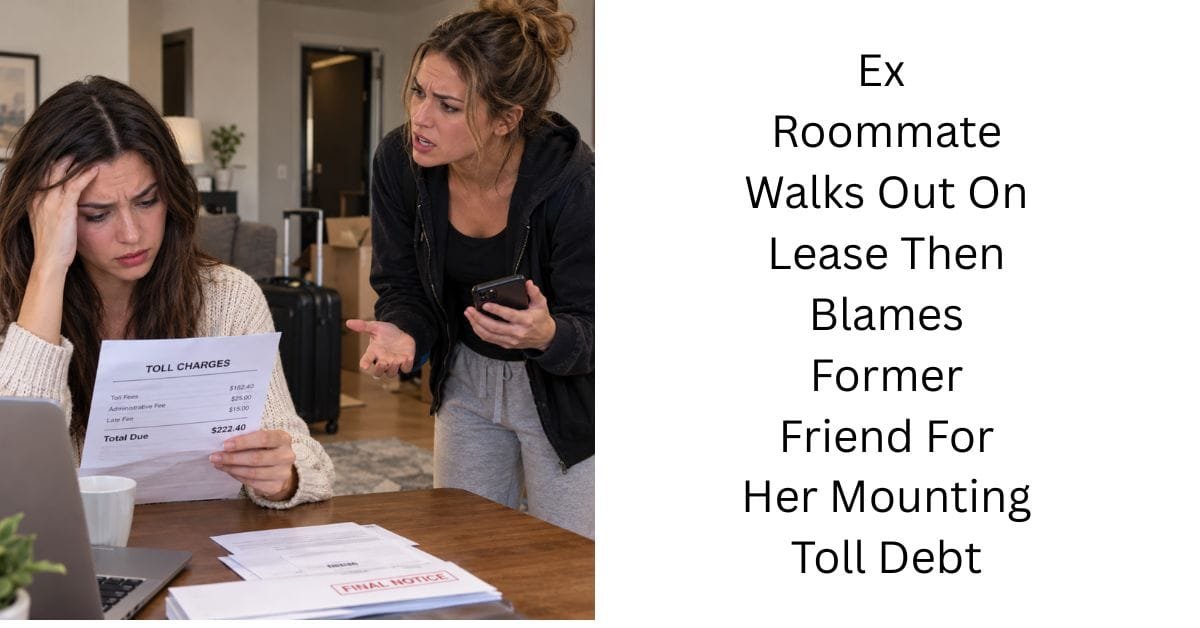
Ex Roommate Walks Out On Lease Then Blames Former Friend For Her Mounting Toll Debt
I never expected a living arrangement with my best friend to completely destroy our friendship, but that’s exactly what happened. My ex-roommate and I used to be extremely close, and when I was looking for a place of my own, she asked me to move into her apartment after her previous roommate suddenly left. I wasn’t particularly interested because I didn’t like the neighborhood and had already started looking at other places. However, instead of letting me move somewhere else, she suggested that we find a new place together. Since we were good friends and splitting the rent would make things significantly cheaper for both of us, I eventually agreed. I made one condition very clear from the beginning: if we signed a lease together, she needed to commit to staying for the full lease term. I didn’t want to be stuck paying for an apartment I couldn’t afford because she changed her mind.
At the time, I genuinely trusted her. We had been friends for years, and I never imagined that she would deliberately leave me in a difficult financial situation. We looked at several apartments and eventually found one that seemed perfect for both of us. The rent was affordable, the location worked for our jobs, and we were both excited about having our own place together. Before signing anything, I reminded her again that this was a serious commitment. She assured me that she understood and had no intention of leaving early. Based on that promise, I signed the lease with her. We moved in and, for a while, everything seemed fine. We decorated the place, split household expenses, and continued our friendship as though nothing could possibly go wrong.
Unfortunately, our friendship began deteriorating not long after we moved in. Small disagreements started becoming bigger arguments. We had different expectations about cleanliness, guests, bills, and how much time we wanted to spend together. Because we had been such close friends, I think we both assumed living together would be easy. Instead, we discovered that being best friends and being compatible roommates were two completely different things. I tried to talk through our disagreements, but eventually the tension became constant. Conversations that should have been simple turned into arguments, and we started spending more time avoiding each other than actually enjoying living together. Despite all of that, I still expected us to honor the lease we had both agreed to.
Then she suddenly told me she wanted to move out. She said she couldn’t handle the living situation anymore and had decided to find somewhere else. I reminded her that we were both legally responsible for the lease and that she couldn’t simply walk away because she was unhappy. She insisted that she would figure something out and seemed convinced that everything would work itself out. I was immediately worried because I couldn’t afford to cover her entire share of the rent indefinitely. I had agreed to the apartment based on the assumption that we would both remain there. If she left, I would either have to find another roommate, negotiate with the landlord, or potentially pay expenses that I had never agreed to take on alone.
Eventually, she moved out anyway. She left behind some of her belongings, but for the most part she started living somewhere else. I was frustrated and hurt, but I tried to handle the situation as responsibly as possible. I contacted the landlord and asked what options were available. I also reminded my ex-roommate that leaving the apartment didn’t automatically erase her responsibilities under the lease. She seemed irritated by that and accused me of making the situation more complicated than it needed to be. According to her, she believed I could simply find someone else to take her place. I explained that finding a replacement roommate wasn’t my responsibility alone, especially since she was the one who had decided to leave.
Things became even more complicated because of a completely separate financial problem involving toll charges. My ex-roommate had apparently accumulated a significant amount of unpaid toll debt connected to her vehicle. Somehow, she began blaming me for part of the situation. I was confused because I had nothing to do with her toll account. I didn’t own her vehicle, I didn’t control her account, and I certainly wasn’t responsible for paying her tolls. She claimed that some of the toll charges had accumulated while we were living together and suggested that because we had shared expenses, I should help deal with them. I told her that living together didn’t make me responsible for every bill she personally incurred.
She became increasingly angry when I refused to pay anything toward her toll debt. She claimed that I was being selfish and that I had “abandoned” her after she moved out. I reminded her that she was the one who broke the agreement we had made about the lease. I had never abandoned her. I was still living in the apartment and paying my share of the expenses while trying to figure out how to handle the situation she had created. If anything, I felt like she had left me with a problem and then expected me to solve it for her. The fact that she was now trying to connect her personal toll debt to our old living arrangement made absolutely no sense to me.
At this point, our friendship was essentially over. It was painful because we had once been incredibly close, and I never imagined that something as ordinary as sharing an apartment could destroy years of friendship. Looking back, I think one of our biggest mistakes was assuming that being best friends automatically meant we would make good roommates. We didn’t discuss enough potential problems before signing the lease, and I trusted her promise that she would stay for the full term. I should have taken the commitment more seriously and made sure there was a clear plan for what would happen if one of us wanted to leave. Trusting a close friend isn’t necessarily wrong, but when money and legal agreements are involved, everything needs to be clearly understood.
I eventually decided that I needed to stop arguing with her and focus on protecting myself financially. I kept records of our conversations, the lease agreement, rent payments, and everything related to the expenses we had shared. I also refused to take responsibility for her personal toll debt simply because she wanted someone else to blame. She made choices involving her vehicle and her finances, and those consequences belonged to her. As for the lease, I continued working through the proper channels to make sure I wasn’t unfairly responsible for her decision to leave. The whole experience taught me a difficult lesson: friendships can change, but written agreements and financial responsibilities still matter. I never thought my best friend would become my ex-roommate and someone I needed to keep records of, but after everything that happened, I realized that sometimes protecting yourself means accepting that a friendship is already over.
Read Story…
AITA for the toll debt of my ex roommate?
My ex-roommate and I did not end on good terms. We were best friends, and I was looking to move out on my own. When she suddenly lost her roommate, she asked me to move in with her. I told her I didn’t like her area and that I was looking elsewhere. Then, she decided to move out of her place and rent something with me instead. I agreed because we were very good friends, and the rent would be cheaper. However, I made it clear that she needed to commit to the lease.
Three months into the lease, she suddenly left without saying anything. Of course, I was upset—I had to find a new roommate. A few months later, she apologized, and I accepted her apology. During this time, she explained the reason she left, admitted it was her fault, and promised that this reason wouldn’t get in the way of our friendship.
She also promised that whenever we met up, she wouldn’t bring this reason into the picture. That turned out to be a lie.
Many of the things she promised not to do to rebuild our friendship, she did anyway, and I eventually decided to remove her from my friend group. Throughout this time, I repeatedly asked her to change her address, and I gave her her mail. When she finally crossed a line I couldn’t tolerate, I just started forwarding her mail to her.
Now, a year later, the mail I forwarded never reached her because she never updated her address, and her toll fines accumulated to a pretty high amount. My ex-roommate blames me because she didn’t get her mail and says she’s going to press charges against me.
I do feel bad, but she left that address over a year ago. I never felt it was my responsibility to manage her mail, and I simply didn’t want any more contact with her.
Am I the asshole? Because I forwarded her mail instead of text her and let her know I was still receiving her mail?
Best Friends Become Ex-Roommates After a Disastrous Living Arrangement
I never expected my best friend to become my ex-roommate and eventually someone I felt like I had to protect myself from financially. We had been extremely close before we ever lived together, and I genuinely trusted her. At the time, I was looking for a place of my own because I wanted to become more independent and have my own space. I wasn’t originally planning to live with her at all. Then her living situation suddenly changed when her roommate moved out, leaving her looking for someone to share the apartment. She asked me if I would move in with her, but I told her honestly that I didn’t like the area and was already looking at other places. I thought that would be the end of the conversation, but instead, she suggested that we find a completely different place together.

Advertisement
The idea actually sounded good at first. We were already close friends, we knew each other’s personalities, and we thought sharing expenses would make things easier. She suggested that we could find a place in an area I liked, rather than expecting me to move into her neighborhood. I agreed because the rent would be considerably cheaper if we split it, and I genuinely believed we would have a great time living together. There was one thing I made very clear before we started looking, though. I told her that if we signed a lease together, she had to be serious about staying. I wasn’t interested in signing a long-term agreement only to discover a few months later that she wanted to leave and expected me to handle everything.
She assured me that wouldn’t happen. She said she wanted stability too and that she was tired of moving around. We talked about our budgets, what kind of apartment we wanted, and how we would divide the bills. Since we were friends, I thought these conversations were enough. Looking back, I realize that I probably relied too heavily on our friendship instead of treating the arrangement like a serious financial agreement. I trusted her word because she had been one of the most important people in my life. I never imagined that I would eventually need to document conversations with her just to protect myself.
We eventually found an apartment that worked for both of us. It wasn’t luxurious, but it was comfortable, affordable, and in a location that I actually liked. We were both excited when our application was approved. We signed the lease, paid the required deposits, and started preparing for the move. I remember feeling relieved because I thought I had finally found a stable place to live. My friend seemed equally excited. We talked about decorating, furniture, household rules, and even having friends over. Everything felt normal, and I had no reason to believe that the arrangement would eventually become one of the biggest mistakes of our friendship.
The first few months were actually pretty good. We moved our belongings in, figured out how to divide the household expenses, and settled into a routine. Because we already knew each other so well, there wasn’t the awkwardness that sometimes happens between strangers. We could joke around, watch movies together, and occasionally go out for food. There were moments when I thought we had made the perfect decision. I felt lucky that I could live with someone I trusted while also saving money.
But living together slowly revealed problems that our friendship had hidden. Being good friends and being compatible roommates turned out to be two completely different things. We had different standards for cleanliness. We disagreed about how often the apartment should be cleaned, how dishes should be handled, and how much clutter was acceptable. We also had different ideas about guests. Sometimes she would invite people over without discussing it with me, while I preferred knowing ahead of time. None of these issues seemed huge individually, but they gradually created tension.
Our communication also started changing. When we were friends who didn’t live together, disagreements were easy to avoid because we could simply go home at the end of the day. As roommates, there was nowhere to escape. If one of us was annoyed, the other person could feel the tension immediately. Small comments started turning into arguments. Things that would have been funny before suddenly felt personal. I tried several times to talk things through because I didn’t want our friendship to fall apart, but the more we discussed our problems, the more defensive she seemed to become.
Eventually, I realized that she wasn’t happy living with me either. We were both frustrated, and our friendship was starting to suffer because of the living arrangement. Even then, I still expected us to honor the lease. I told her that if living together wasn’t working, we could at least finish the lease period and then go our separate ways. That seemed like the most responsible option. We had both agreed to the contract, and I had planned my finances around the assumption that we would both be paying our shares.
Then one day she told me she wanted to move out early.
I honestly thought she was joking at first. I reminded her that we had discussed this before signing the lease. I told her that I couldn’t suddenly afford to cover her portion of the rent by myself. She said she understood but insisted that she couldn’t continue living there. I asked whether she had found another place and whether she planned to keep paying her share until the lease was officially transferred or ended. She became irritated and said she didn’t think it should be that complicated.
That was the first moment I realized how differently we viewed our agreement. To me, signing the lease meant making a commitment. To her, it seemed like something she could walk away from if the situation became uncomfortable. I reminded her that I had specifically told her I would only agree if she was willing to commit to the lease. She said she remembered that conversation but claimed circumstances had changed. I understood that circumstances could change, but I didn’t think that automatically transferred her financial responsibilities to me.
She eventually started moving her belongings out. Watching her pack was incredibly strange because this was someone I had once considered one of my closest friends. I wanted to be angry, but mostly I felt disappointed. I kept thinking about how different everything would have been if she had simply communicated with me before signing the lease. We could have found separate places from the beginning. Instead, I had trusted her promise and made financial decisions based on it.
Once she moved out, I was left trying to figure out what to do. I contacted the landlord and explained the situation. I wanted everything handled properly rather than simply pretending the lease no longer mattered. The landlord explained the options available under the agreement and made it clear that my roommate’s decision to move elsewhere didn’t automatically erase her obligations. That was a relief because at least I wasn’t the only person saying this.
My ex-roommate, however, didn’t seem to agree. She kept insisting that because she wasn’t physically living there anymore, she shouldn’t have to continue dealing with the apartment. I explained that living somewhere and being financially responsible for a lease were not necessarily the same thing. She had signed the same agreement I had. If she wanted to leave early, she needed to follow the proper process instead of simply disappearing.
Our conversations became increasingly unpleasant. She accused me of making her life difficult and said I was acting like I cared more about money than our friendship. I told her that this wasn’t about choosing money over friendship. The friendship was already being damaged by the situation. I was simply trying to avoid being financially harmed because she had changed her mind about something we had agreed to together.
Then another problem appeared that I never expected.
She started talking about unpaid toll charges connected to her vehicle.
Apparently, she had accumulated a growing amount of toll debt, and she was frustrated about how much she owed. At first, I assumed she was simply venting to me about her own financial problem. I listened, but I didn’t think it had anything to do with me. Then she started suggesting that some of the responsibility should fall on me because we had lived together.
I was completely confused.
I asked her exactly what she meant. She explained that some of the toll charges had accumulated while we were roommates and implied that I should help pay them. I asked whether my name was on the vehicle or the toll account. It wasn’t. I asked whether I had been driving her car when the charges were incurred. I hadn’t. I couldn’t understand why she thought I should be financially responsible for a debt associated with her vehicle.
She argued that we had shared expenses and that I had benefited from having access to her vehicle at times. I reminded her that occasionally riding in someone’s car doesn’t make you responsible for their unpaid toll bills. If she had driven through toll roads and failed to pay the charges, that was something she needed to resolve with the relevant toll authority. I had no control over her account, her vehicle, or her payment history.
That’s when she became much more upset.
She accused me of refusing to help her when she was already struggling financially. She said I knew how difficult things had become for her and that I was being selfish. I told her that I was sorry she was dealing with financial problems, but that didn’t mean I could accept responsibility for bills that weren’t mine. I was already dealing with the consequences of her leaving the apartment early. I wasn’t going to add her personal debt to my own responsibilities simply because she was angry with me.
She then tried to connect the toll issue to the apartment again. She said that because some of the toll charges had happened during the time we lived together, the debt was somehow part of our shared financial situation. I told her that wasn’t how personal debts worked. Sharing rent and utilities doesn’t mean roommates automatically become responsible for each other’s unrelated debts. If that were true, every roommate in the world would be responsible for every parking ticket, credit card balance, speeding ticket, or personal bill belonging to the other person.
At this point, I stopped trying to convince her emotionally and started focusing on documentation. I saved our messages, kept copies of the lease, recorded my rent payments, and organized anything that showed what expenses I was actually responsible for. I wasn’t doing this because I wanted to attack her. I simply didn’t trust that the situation would remain verbal. Every time we talked, the story seemed to change slightly, and I wanted to make sure I had a clear record of what had actually happened.
The saddest part was remembering how close we had once been. We used to tell each other almost everything. We celebrated birthdays together, supported each other through difficult situations, and talked about our future plans. If someone had told me years earlier that we would eventually be arguing about rent, lease obligations, and toll debt, I probably would have laughed. I never imagined that moving in together would completely change the way I saw her.
Looking back, I think we made the classic mistake of assuming friendship automatically makes someone a good roommate. It doesn’t. You can love someone as a friend and still have completely different habits when it comes to money, cleanliness, privacy, guests, schedules, and responsibility. We didn’t have enough serious conversations about what would happen if one of us wanted to leave. I trusted her promise because she was my friend, and I didn’t think I needed to protect myself from someone I trusted.
I also learned that verbal promises aren’t enough when significant money is involved. Before signing another lease with anyone, even someone I have known for years, I would make sure every important responsibility is clearly understood. Who pays what? What happens if someone moves out? Can another roommate replace them? What happens to the deposit? What happens if someone stops paying? Those aren’t romantic conversations, but they’re necessary ones.
As for the toll debt, I eventually stopped responding to arguments about it. I told her clearly that I wasn’t responsible for her personal toll charges and that I wouldn’t discuss them further. If she believed otherwise, she could provide documentation showing why I was legally or financially responsible. She never provided anything that changed my position. Instead, she continued to express frustration about how much debt she had accumulated.
The lease situation took more time to resolve. I continued communicating with the landlord and doing what I could to make sure the apartment remained in good standing. I wasn’t going to intentionally stop paying my portion simply because I was angry with her. Whatever happened between us, I didn’t want my own credit or financial situation damaged. I also didn’t want to create additional problems for the landlord.
Eventually, we stopped speaking regularly. There wasn’t one dramatic final argument where we officially declared that our friendship was over. It simply faded after enough disagreements and accusations. Every conversation seemed to revolve around money, responsibility, or blame, and eventually there wasn’t much left of the friendship we had before.
I still think about whether I could have handled things differently. Maybe I should have insisted on a written roommate agreement in addition to the lease. Maybe I should have asked more questions before signing. Maybe I should have recognized that our friendship wasn’t necessarily proof that we would live well together. But I also don’t think I can blame myself for trusting someone who had given me no reason at the time to believe she would abandon the arrangement.
The biggest lesson for me is that boundaries become especially important when friendship and money overlap. I can care about someone without taking responsibility for their financial decisions. I can understand that someone is struggling without agreeing to pay their bills. And I can be disappointed by someone’s choices without trying to punish them. My ex-roommate made the decision to leave the apartment, and she also accumulated toll debt that wasn’t mine. I don’t hate her, but I no longer feel comfortable mixing friendship and finances with her.
In the end, I never expected a person I once considered my best friend to become someone I had to keep financial records about. The apartment itself wasn’t the biggest loss. The friendship was. I had agreed to live with her because I believed our friendship made us trustworthy enough to share a home. Instead, the experience taught me that trust doesn’t mean ignoring practical protections. Sometimes the healthiest thing you can do is separate your finances from your relationships, put agreements in writing, and accept that someone who was once very close to you may eventually become a person you need clear boundaries with.