My Sister Says I Should Help Pay $12,000 to Freeze Her Eggs
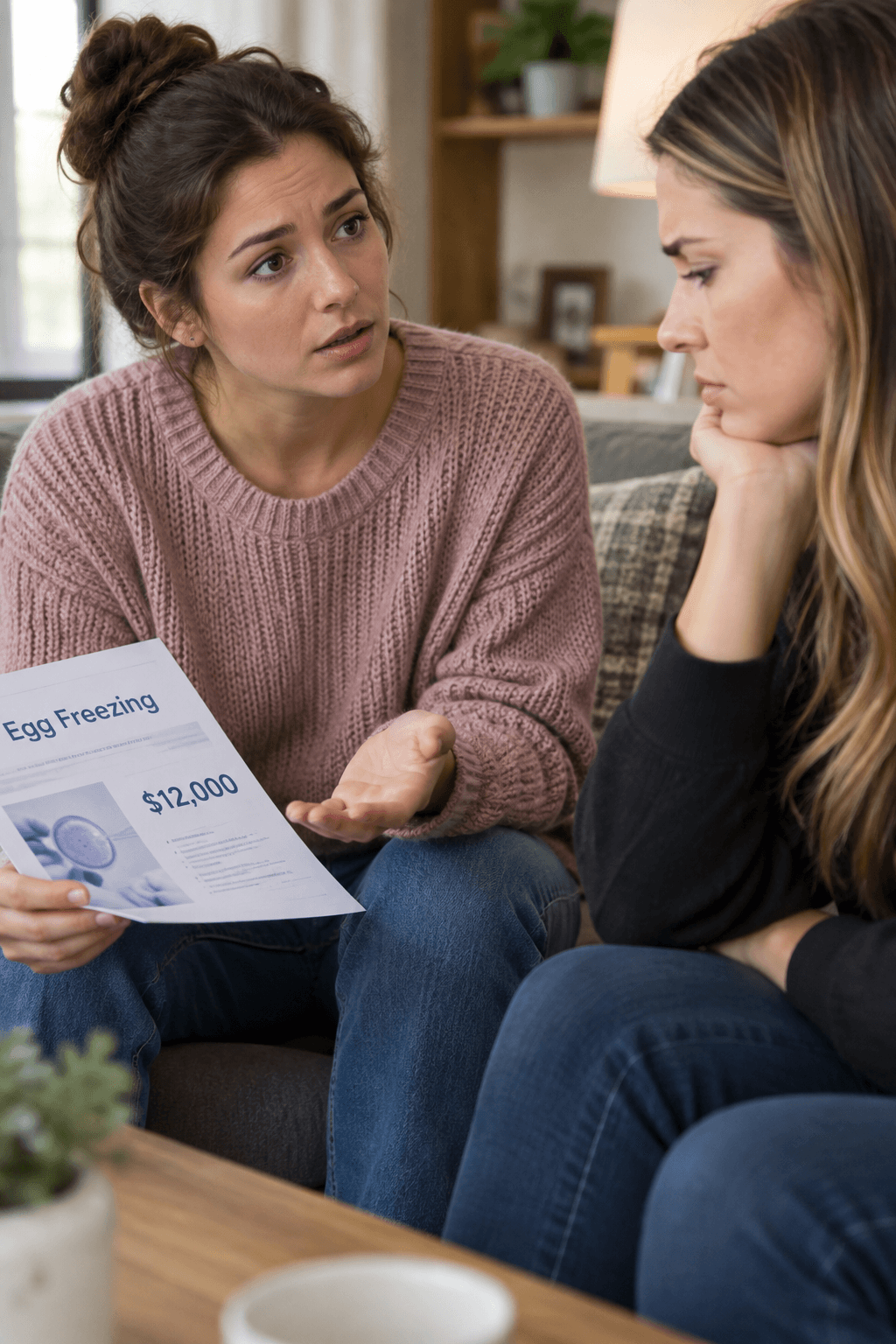
I never expected a conversation about money between my sister and me to become so emotional, but everything changed when she asked me to help pay $12,000 for her egg-freezing procedure. My sister is in her early thirties, has a good career, and has always been very independent. She has never been the type of person to ask our family for financial help, which is one reason her request caught me completely off guard. She explained that she wasn’t ready to have children right now but wanted to preserve the possibility of becoming a mother later in life. According to her, freezing her eggs would give her more time to focus on her career and personal life without feeling pressured by her biological clock. She had researched the process carefully and told me that the total cost, including medication and the procedure, would be around $12,000. I understood why the decision mattered to her, and I never judged her for wanting to do it. What I didn’t understand was why she believed I should help pay for it.
When she first brought up the subject, I assumed she was simply telling me about her plans. We talked about the procedure, how expensive it was, and how she had been saving for it. Then she suddenly asked if I would be willing to contribute a few thousand dollars. I honestly thought she was joking at first. I asked her what she meant, and she explained that she believed it would be fair for me to help because I was in a better financial position than she was. She said she wasn’t asking me to pay the entire $12,000, but even a contribution of $3,000 or $4,000 would make things much easier for her. I told her that I understood how important this was to her, but I wasn’t comfortable giving that amount of money for a personal medical and family-planning decision that wasn’t mine to make. She immediately became upset and said I was treating her situation like it was some unnecessary luxury. That wasn’t what I meant at all. I simply believed that wanting to preserve her fertility was her decision, and therefore the financial responsibility should primarily belong to her.
The conversation became much more complicated when she started comparing our financial situations. She pointed out that I had fewer major expenses and suggested that I could afford to help without seriously affecting my life. She reminded me of times when our parents had helped me financially and said that siblings were supposed to support each other when something really mattered. I agreed that family should support one another, but I didn’t think support always meant handing over thousands of dollars. I offered to help her in other ways. I said I could help her research clinics, look for payment plans, compare financing options, or even help with smaller expenses if she genuinely needed it. She rejected all of those suggestions because, according to her, what she really needed was cash. Then she said something that bothered me deeply. She told me that if I could spend money on vacations, restaurants, and other things I enjoyed, I should be able to spend money helping my own sister potentially become a mother someday. That comparison felt unfair because my savings weren’t sitting around without a purpose. I had worked hard to build them, and I had my own future plans and responsibilities.
Things became even worse after she spoke to our parents. My sister apparently told them that I had refused to help her with something that could have a major impact on her future. My parents called me and asked why I couldn’t simply contribute something. They weren’t demanding that I pay the entire amount, but they clearly thought I should do more. My father said that $12,000 was a huge amount of money and that my sister was probably feeling scared about getting older and losing options. I understood that, but I also felt like everyone was focusing on her emotions while completely ignoring mine. Nobody asked whether I had plans for my savings or whether giving away several thousand dollars would make me uncomfortable. When I explained that I wasn’t refusing to support my sister emotionally, I simply didn’t want to finance the procedure, my mother said I was being too rigid. She reminded me that there might come a time when I needed my sister’s help too. That comment made me realize that this wasn’t really about the procedure anymore. It had become a question of whether family members were allowed to say no when another relative asked for a large amount of money.
Eventually, I sat down with my sister and tried to have one final honest conversation without our parents involved. I told her that I loved her, supported her decision, and genuinely hoped everything worked out for her, but I couldn’t accept the idea that supporting her meant I was obligated to pay thousands of dollars. I told her that if she wanted to freeze her eggs, I respected that completely, but it was still her personal choice and financial responsibility. I offered once again to help her find affordable options or work out a realistic savings plan, but I wouldn’t hand over the money simply because she believed I could afford it. She became quiet for a moment and then admitted that she had been feeling overwhelmed by the cost and had hoped I would make the decision easier for her. I understood that she was scared, but I also knew that saying yes would create resentment on my side. In the end, I told her that I would always be her brother/sister and would support her emotionally, but I couldn’t become financially responsible for a decision about her future fertility. We haven’t completely returned to normal since that conversation, but at least the boundary is clear. I still hope she achieves everything she wants, including becoming a mother if that’s what she eventually chooses. I just don’t believe loving someone means you automatically have to pay thousands of dollars whenever they ask.
Read Story…
“My Sister wants 12 Thousand Dollars to Freeze Her Eggs”
My sister, “Rose,” and I are both in our late 30s, but she has always been supported by our parents. I think she suffers from anxiety and possibly mild bi-polar disorder, but to my knowledge she’s never been diagnosed so I don’t know for sure. However, I strongly believe that my parents are hurting her rather than making things better. They have a very co-dependent relationship, which I feel has isolated her from her peers and has contributed to her low self-esteem. I think if they withdrew support or at least strongly encouraged her to seek mental health help, she would be in a much better spot.
Rose has always wanted children, but since she is afraid to date and works sporadically (she quits when things become stressful), she has never had a serious relationship or been in a position to make children happen. Now that she’s approaching 40, she realizes that she’s running out of time. She recently asked me to lend her $12k to freeze her eggs so that she can use them later when she’s self-sufficient.
At first I felt like it was something I had to do; it’s heartbreaking to think that if I don’t, I might be standing in the way of Rose becoming a parent. But after thinking it over more, I just don’t know if it’s the right thing to do. I’m extremely doubtful at this point that anything is going to change in her situation. And I feel that in giving her the money I’ll be making the same mistake my parents have made. Finally, in her current state, I just don’t think she’d be a stable/healthy parent.
Ideally, I’d love to help her get to a stable point and then help her with fertility, but I’m not sure there is time for that. And my efforts to help her in the past haven’t panned out.
Thank you for any advice you can offer! — My Sister’s Keeper
I think you already know what the “right” answer is here, as much as a situation like this can have a “right” or a “wrong” answer. It’s all terribly unfair. It’s unfair that Rose struggles with mental health issues. It’s unfair that the ability to become a mother is dependent on so many things out of one’s control and that the ability to provide for a child is also dependent on many things out of one’s control. It’s unfair that you’ve been tasked with a moral dilemma that threatens your relationship with a close family member. There’s so much that is unfair in this situation, and I’m sorry you’re in it.
You already know what you have to do, but it doesn’t feel good, and those are always the hardest decisions to make – the ones that feel so hard. It may help, then, to think about both the likely scenarios and the worst-case scenarios in each choice you could make and consider what would be less awful to live with. The likely scenario is you loan Rose $12k and you never see that money again and it doesn’t result in your sister becoming a mother. That’s something you might be able to live with just fine, especially if it meant preserving your relationship with Rose (which could only happen if you truly gave that 12k to her with zero expectation of its being returned to you and little anxiety of its resulting in a child your sister would be unable to care for adequately).
I don’t need to tell you what the worst-case scenario would be if you give Rose the money, but what would be the worst case if you don’t? Maybe she refuses to talk to you again? Maybe she harbors resentment against you for a long time? Maybe she’ll blame you for her never becoming a mother and, maybe worse, you’ll blame yourself for standing in the way of Rose’s lifelong dream? All of these are possible outcomes, and they’re all heartbreaking. I can understand any desire you might have to avoid them. But avoiding these outcomes is not dependent on your actions, your behavior, your giving your sister money to freeze her eggs. More than anything, the outcomes you wish to avoid are dependent on your sister achieving some emotional stability and self-sufficiency. In fact, you hardly have any power in this situation at all. Whether you give or don’t give your sister money, a positive outcome can only be achieved if your sister gets the mental health help she needs. Your giving her money is not going to nudge her in that direction at all, but telling her no just might.
You need to tell her that you want to support her in pursuing her dreams, as your past efforts have proven. Tell her that the kind of support you’ve offered in the past still stands, and if and when she’s ready to address her mental health needs, you’ll be there for her. But until then, you cannot in good conscience support her pursuit of motherhood when you haven’t seen evidence yet of Rose taking the first steps toward prioritizing her mental health, which would enable her to better care for a child. This won’t feel good, but that doesn’t mean it’s wrong. The path of least resistance often fails to lead us in the best direction.
Sister Asks for $12,000 to Freeze Her Eggs, Leaving Her Sibling Torn Between Supporting Her Dream and Setting Boundaries
I never imagined that a conversation about my sister’s future would put me in a position where I had to choose between supporting her dream and protecting a boundary I had spent years trying to establish. My sister, Rose, has always wanted to become a mother someday. She has talked about having children for as long as I can remember, even during periods when the rest of us were focused on school, careers, relationships, and simply figuring out adulthood. Recently, however, she became increasingly worried that she might not be ready for motherhood before her fertility became a concern. She started researching egg freezing and eventually found a clinic where the procedure, medications, testing, and related expenses would cost around $12,000. She told me she wanted to do it now so she could preserve the possibility of having biological children later.
At first, I didn’t think there was anything controversial about her decision. It was her body, her future, and ultimately her choice. I listened while she explained everything she had learned about the process. She talked about the appointments, the injections, the retrieval procedure, and the possibility that she might need more than one cycle. She had clearly spent a lot of time thinking about it. I told her that if this was something she genuinely wanted, I hoped everything went well. I assumed the conversation would end there. I had no idea that she was eventually going to ask me for thousands of dollars to help make it happen.
A few days later, Rose brought the subject up again. This time, she told me she had been looking at her finances and realized that paying the entire $12,000 herself would be difficult. She said she had some savings, but using most of them would leave her feeling financially vulnerable. Then she asked whether I would be willing to contribute toward the procedure. I asked how much she had in mind, expecting perhaps a few hundred dollars. Instead, she said she was hoping I could help with several thousand. She explained that because I was in a better financial position, she thought it would make sense for me to help her secure her future.
I was honestly stunned. I understood why she was worried, but I didn’t understand why the solution had become my responsibility. I asked her whether she had considered financing, payment plans, additional time to save, or other options. She said she had considered some of them but didn’t like the idea of taking on debt or delaying the procedure. She wanted to move forward as soon as possible. Then she reminded me that I had helped her financially in the past. That was true, but the circumstances had been very different.
Over the years, I had helped Rose several times when she was struggling. I had paid for unexpected expenses, helped her cover bills during difficult periods, and supported her in ways that I thought were reasonable. I never regretted helping her because she was my sister. However, there had always been an understanding that those situations were temporary emergencies or things where my assistance could genuinely make a difference without creating a long-term financial obligation. This felt completely different. Egg freezing was a major personal decision, and the cost wasn’t something I could simply absorb without thinking about it.
Rose didn’t see it that way. She told me that I was looking at the situation too practically. She said this wasn’t just another purchase or expense. In her words, it was about preserving her chance to become a mother in the future. She said that if she waited too long, she might regret it for the rest of her life. I understood the fear behind what she was saying. Nobody can know exactly what their future will look like, and I could understand why she wanted to preserve her options.
The problem was that there were other concerns surrounding Rose’s plans that she didn’t seem willing to acknowledge. Rose has struggled with mental health issues for years. I’m not saying that someone with mental health challenges can’t be a good parent. I don’t believe that at all. But in Rose’s particular situation, she had repeatedly struggled to take care of her own basic needs during difficult periods. There had been times when she stopped attending appointments, neglected responsibilities, isolated herself from everyone, and refused professional help even when people close to her encouraged her to seek it.
I had supported her through many of those periods. I had listened to her late at night, driven her places when she needed help, helped her organize practical things, and encouraged her to speak with professionals. I never expected her to become perfect before pursuing her dreams. What worried me was that she seemed focused entirely on securing the possibility of motherhood while avoiding the underlying issues that could make motherhood much harder for her later.
When I tried to explain this, Rose became extremely upset. She thought I was saying she didn’t deserve to become a mother. That wasn’t what I meant. I told her that wanting children was completely understandable and that I wasn’t trying to take that dream away from her. I simply believed that if she wanted my financial support for such a major decision, I needed to feel comfortable with what I was supporting. She told me that my concerns were judgmental and that I was using her mental health against her.
That accusation hurt because I had never used her struggles against her. In fact, I had spent years trying to support her without making her feel defined by them. I told her that the support I had offered in the past still stood. If she decided she was ready to address her mental health needs and wanted help finding appropriate professional support, I would be there. I would listen, help her research resources, drive her to appointments if needed, and support her emotionally. But I couldn’t honestly say that I was comfortable paying thousands of dollars toward a future parenting plan when I hadn’t yet seen her take meaningful steps toward becoming more stable herself.
Rose didn’t accept that explanation.
She told me that I was setting an impossible standard. According to her, nobody could guarantee that they would be mentally or emotionally prepared for parenthood. She said people changed after having children and that becoming a mother might actually give her more motivation and purpose. I told her I understood that possibility, but I didn’t think having a child should be treated as the solution to existing problems. A child would deserve a parent who was prepared to care for them, regardless of whether parenthood happened to improve the parent’s life.
That conversation ended badly. Rose stopped responding to my messages for several days. Eventually, our parents became involved. My mother called and asked what had happened. She said Rose was devastated because she believed her own family wasn’t supporting her dream. I explained my side and emphasized that I wasn’t trying to stop Rose from freezing her eggs. I simply didn’t want to contribute $12,000—or even several thousand dollars—to a decision I wasn’t comfortable financing.
My father was more understanding, but even he asked whether I could compromise by giving her a smaller amount. He said that perhaps contributing $1,000 would show Rose that I supported her without taking full responsibility for the procedure. I thought about it seriously. The problem was that I knew giving money would probably not solve the underlying disagreement. Rose wasn’t really asking whether I could spare $1,000. She wanted me to demonstrate that I believed in her decision.
I eventually realized that money wasn’t actually the central issue. She wanted emotional validation, financial assistance, and reassurance that her family believed she was ready for this next stage of life. I could give her the first and third without giving her the second. I could tell her that I loved her, that I believed she deserved to pursue her goals, and that I hoped she would eventually have the family she wanted. But I couldn’t pretend that my financial contribution was something I was comfortable making.
I also started questioning whether saying yes simply because refusing would hurt her feelings would actually be helpful. If I gave her several thousand dollars, I knew there was a good chance I would become resentful later. If the procedure required another cycle, would she ask again? If she eventually needed additional fertility treatment, would I be expected to contribute again? If she became pregnant and needed financial help with the baby, would the expectation continue? I didn’t want our relationship to become a series of financial negotiations.
Rose argued that I was making assumptions about the future. She said she wasn’t asking me to fund a child, only to help preserve her eggs. That was technically true, and I acknowledged it. But I still believed I was allowed to decide where my money went. Supporting someone emotionally doesn’t automatically mean agreeing to finance every major decision they make.
Eventually, I sat down with Rose and tried to explain everything without turning the conversation into another argument. I told her that I wanted to support her dreams, just as I had tried to support her in the past. I reminded her that the kind of help I had given before was still available. If she wanted to work on her mental health, build more stability, and get the support she needed, I would stand beside her. I wasn’t asking her to prove that she was perfect. I was asking her to show that she was taking her own well-being seriously.
I also told her that this wasn’t about deciding whether she deserved to become a mother. Nobody could make that decision for her. I simply couldn’t, in good conscience, financially support the pursuit of motherhood while I was still concerned that she hadn’t taken the first steps toward addressing problems that could affect her ability to care for herself and eventually a child. I knew those words wouldn’t feel good to hear, but I would rather be honest than give her money while secretly feeling uncomfortable about it.
Rose cried during that conversation. She said she felt like everyone was looking at her as though she were broken. I told her that wasn’t how I saw her. I saw my sister as someone who had struggled, survived difficult periods, and still had dreams for her future. I wanted those dreams to happen. I simply wanted her to take care of herself along the way. I told her that needing help didn’t make her weak and that asking for professional support wasn’t something she should be ashamed of.
For a while, neither of us knew what would happen next. Rose remained angry, and our relationship became more distant. She eventually stopped bringing up the $12,000, but I could tell the issue hadn’t completely disappeared. Meanwhile, I continued to make it clear that I wasn’t abandoning her. I checked in on her, invited her to family events, and reminded her that if she ever wanted help finding appropriate mental-health support, I would help her look.
I don’t know whether Rose will eventually decide to freeze her eggs. She may find another way to pay for it, she may save longer, or she may decide that the procedure isn’t right for her. That’s ultimately her decision. I also don’t know whether she will ever agree with my reasons for refusing to contribute. Maybe someday she’ll understand where I was coming from, or maybe this will remain something we disagree about for years.
What I do know is that I can’t make major financial decisions based entirely on guilt. Rose is my sister, and I love her. That’s exactly why this situation has been so difficult. If I didn’t care about her, saying no would be easy. Instead, I’ve spent countless hours wondering whether I could have handled things differently or whether I should have simply given her the money and avoided the conflict.
But sometimes the easiest path isn’t necessarily the right one for a relationship. Giving her money would have made the immediate problem disappear, but it wouldn’t have addressed the concerns that led me to hesitate in the first place. I don’t want to control Rose’s life, and I don’t want to decide whether she should become a mother. I want her to have the opportunity to pursue her dreams while also taking care of herself.
For now, that’s where things stand. I still support my sister, but I have drawn a financial boundary. I have told her that the emotional and practical support I’ve offered in the past is still there, and if she’s ready to prioritize her mental health, I’ll be there beside her. What I can’t do is hand over thousands of dollars simply because saying no makes me feel guilty. I know Rose may disagree with me, and maybe some people will too. But I have learned that loving someone doesn’t always mean making the choice that creates the least conflict. Sometimes love means being honest, even when the honest answer is painful.