Adopted Woman Seeks Medical History From Biological Father, But His Furious Wife Blocks Her Attempts
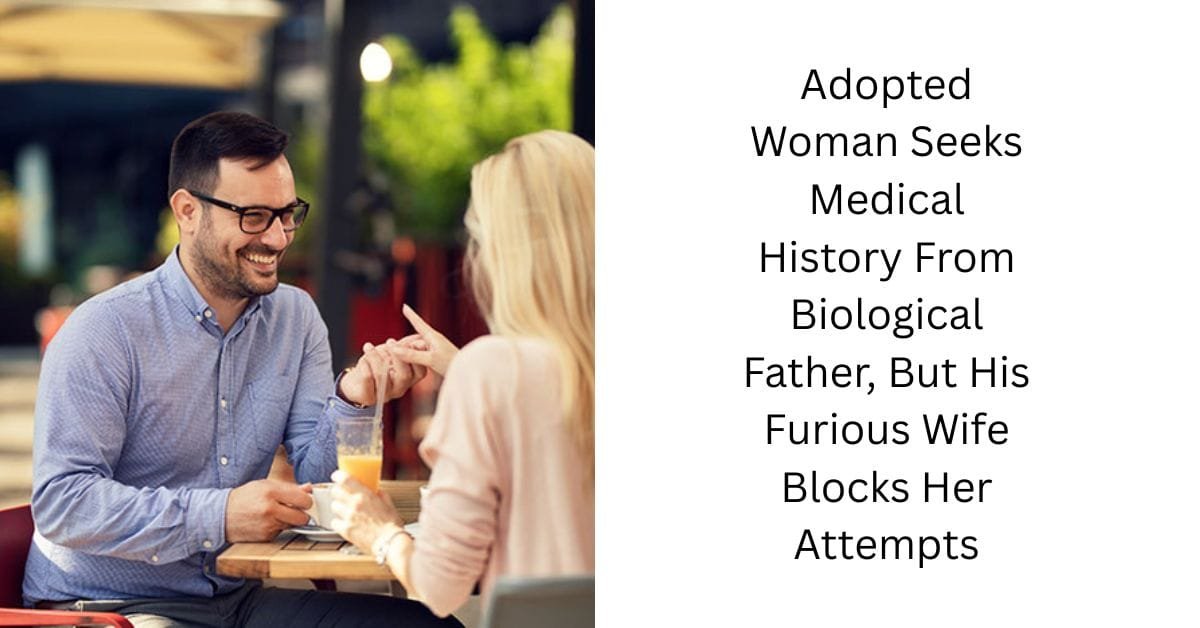
For thirty-two-year-old Emily, growing up adopted meant that there were always unanswered questions about where she came from. She had loving adoptive parents who had raised her with patience and care, and she never blamed them for the circumstances surrounding her adoption. Still, as she became an adult and eventually started thinking more seriously about her own future, she found herself increasingly curious about her biological family. She did not necessarily want a relationship with her biological parents or expect them to suddenly become part of her life. What she wanted most was basic medical information. She had begun realizing how important family medical history could be when doctors asked about conditions that had affected her parents, grandparents, and siblings. Unfortunately, whenever Emily was asked about inherited illnesses, she could only say that she was adopted and did not know. After years of avoiding the subject, she finally decided to contact her biological father and politely ask whether he could provide any information about serious medical conditions that ran in his family.
Emily’s first message to her biological father was carefully written because she did not want him to feel pressured. She explained that she understood he had his own life and that she was not contacting him to disrupt his family. She simply wanted to know whether there were any significant hereditary conditions, including heart disease, cancer, diabetes, neurological disorders, or other illnesses that might be important for her doctors to know about. Her biological father initially responded, and Emily was relieved that he seemed willing to answer some basic questions. However, the situation quickly changed when his wife discovered the communication. According to Emily, his wife became extremely angry and accused her of trying to enter their family after being absent for decades. She allegedly told Emily that she had no right to demand information from a man who had moved on with his life. Emily repeatedly explained that she was not asking for money, emotional support, or a relationship. She only wanted medical history that could potentially help protect her health in the future.
The biological father’s wife reportedly became even more hostile after learning that Emily wanted additional information. She began blocking Emily’s messages and eventually prevented her from communicating directly with her biological father. Emily found the situation deeply upsetting because she felt as though she was being treated like a threat simply for wanting answers about her own genetics. She understood that her biological father had a right to maintain boundaries, but she struggled to understand why asking about medical history had become such a serious conflict. Emily’s adoptive mother tried to reassure her that she had done nothing wrong and that being curious about her biological background was completely natural. Still, Emily could not stop thinking about the possibility that there might be important information about hereditary conditions that she would never know. She even wondered whether her biological father had information about illnesses that had affected close relatives but had never been documented in the adoption records.
Advertisement
Eventually, Emily decided that she needed to stop trying to force contact. Instead, she began exploring other ways to learn about her biological family history. She looked into adoption records, medical genealogy resources, and genetic testing, hoping that one of those options might provide at least some answers. Although none could completely replace information directly from a biological parent, Emily realized that she could not allow the conflict with her father’s wife to consume her life. She also began to question whether she had been expecting too much from the situation. On one hand, she believed everyone should have access to important medical information about their biological relatives whenever possible. On the other hand, she recognized that her biological father might have complicated feelings about the past and that his wife might genuinely fear that renewed contact could change their family dynamic. Emily ultimately decided that she would respect their decision not to communicate while leaving the door open if her biological father ever wanted to share information voluntarily.
Advertisement
The experience left Emily with mixed emotions. She was disappointed that something as seemingly simple as asking about family medical history had turned into such a painful confrontation. At the same time, she became more understanding of the complicated emotions surrounding adoption and biological families. She knew that she could not change the circumstances of her birth or force another person to participate in her life. What she could do was continue caring for herself, communicate honestly with her doctors about what she did not know, and pursue whatever legitimate resources were available to her. Emily also hoped that one day her biological father might reconsider and understand that her questions were never intended as an attempt to take his family away from him. She simply wanted to know where she came from and whether there was anything in her biological history that could help her make informed decisions about her future. Do you think Emily was wrong for asking her biological father about his family’s medical history, or should she have respected his wife’s wishes and stopped contacting him sooner?
Read Story…
Bio Dad’s Wife inserts herself in OP’s attempts to establish contact, share medical history
I am NOT OP. Original post by u/Throwawayadoptedgirl and shared with permission.
Fun Fact for Mobile Spoilers: In Scottish and Pictish myths, purple heather gets its color from blood spilled in battle while white heather grows where no blood was shed. Other myths say the rarer white heather plant grows over the final resting place of faeries. Heather also features in the Scottish legend of Oscar and Malvina: Oscar, killed in battle the day before their wedding, requests a sprig of purple heather taken to his betrothed Malvina whose tears turned the purple blossoms white.
Estimated Reading Time: ~11 minutes
trigger warnings: infidelity, abandonment, medical crises
mood spoilers: hopeful
My (19F) biological father’s (45m) wife (40F) said she wants me to “leave them alone”. – 31 July 2021
Okay, this is gonna be kinda long because the amount of drama leading up to this is ridiculous. Usually I’d just summarize, but the context is important. I’m gonna change names and specific locations cause I don’t want to get tracked down and found out and stuff.
BACKSTORY:
It all started a few months before I was even conceived. My biological mother, let’s call her Chloe, was engaged to a man who we will call Karl. So Chloe was working at a Walmart while engaged to Karl, and decided to cheat on him with her boss, who we’ll call Harold. So Harold had no idea Chloe was engaged until they had been dating for a while. Things are going well between them until one day Harold catches Chloe on a date with his best friend. This leads to a big fight where Chloe hits Harold and he has to lock her out of the house to protect himself. She calls the police on him, and due to the crappy domestic dispute laws in their state, they BOTH spend the night in jail. Somehow Harold is blamed for the incident and is ordered to take 2 years of anger management, and decides to never speak to Chloe again.
A few weeks later Harold gets a text from one of his friends, telling him that Chloe is pregnant and that Harold is the father. He immediately calls bullshit, because Chloe is not only engaged to another man who is probably the father, but was also being intimate with MANY other men. So he brushes it off and forgets about it. A couple months pass, and Harold gets a call from an adoption agency saying that they need to talk to him. Chloe has decided to give the baby (hey! That’s me!) up for adoption, and Harold needs to sign some papers since she put him down as the father. He agrees to sit down with someone from the agency, but only to talk to them about the claims. So he meets a representative and tells them that he doesn’t think he’s the father. The guy from the agency goes “Oh, great! Just sign here then!”, and hands Harold the documents to surrender his rights as a father. Harold signs them and doesn’t hear anything from them again.
Meanwhile with Chloe, she has the baby (with her fiancé in the room, which gives me infinite respect for him), and the baby is adopted 3 days later. Unfortunately, the baby (who is me) was born with a slew of genetic illnesses. I end up in the hospital only 20 days later because my kidney was collapsing in on itself. To save time, let’s just say that growing up I spent a disgusting amount of time in the hospital. My health was in a perpetual downward spiral, and every time we found a solution to one problem, a new one would pop up and wreak havoc on my tiny body. It all came to a head one day when I was 13, when I was in so much pain that my doctors thought I was having a heart attack. I wasn’t, but hadn’t been diagnosed yet, so they had no clue.
So after being told by my doctors in the hospital that I had a heart attack, my adopted dad, who we’ll call Markus, freaked out and finally reached out to Harold for the first time. He asked for his medical records so that they could better assess the situation and decide what to do. Here is where the problems started.
THE FIRST INCIDENT:
So while I was busy being cripplingly ill, Harold had forgotten all about me and started a new life with a woman he met a month after my birth, let’s call her Heather because she reminds me of Heather Duke. They had 2 sons at the time, and Harold hadn’t told Heather anything about maybe having another kid. TO CLARIFY I WASN’T THERE FOR THIS PART SO I AM ONLY TELLING WHAT I HAVE BEEN TOLD HAPPENED. So Heather finds the email that my dad sent to Harold and absolutely loses her mind. She thinks he cheated on her or something, and blocks my dad on Facebook and starts messaging Chloe on Facebook.
Now this is where the story gets a little tricky. I have been told 2 different versions of this event and honestly I’m not 100% sure which one is true, so I’ll just tell both.
Chloe’s version: Heather started sending mass amounts of hate and harassment to Chloe, basically telling her to step off and “get away from her man”. Heather insisted that Harold wasn’t the father, and Chloe was lying. By this point in time Chloe was already married and had 2 daughters that she kept (one who belonged to her old fiancé, and one who belonged to her current husband). She had also built a relationship with me! She read me some of the messages that Heather sent during a weekend I was spending with her and my half sister almost 4 years later. She said, I quote, “Her grammar was atrocious, but I didn’t think correcting it was the right way to go.”
Heather’s version: Heather reached out to Chloe to talk to her about the situation and what she wanted them to do. Chloe snapped at her and said there was no way that my parents would put me through a paternity test. Because Chloe said that, they decided not to pursue the test.
After these communications all contact was lost and my dad lost Harold’s cellphone number. The whole interaction ended with no paternity test, and no medical records.
RECENT EVENTS:
Okay now that that’s out of the way, here is what has happened in the last month. So my health has progressively gotten worse and, and I now have to apply for disability if I want to pay for my ungodly amount of medications. The lawyer I hired said that having a full family medical history might be helpful. So I asked my super smart friend to track Harold down so I could contact him. Long story short, I got his number and I left him a voicemail that was basically me just begging him to help me saying I was sorry for intruding on his life and begging for him not yell at me.
He called back after like 20 minutes, and to my extreme surprise he was happy to hear from me! He said that not contacting me was one of the biggest regrets of his life. We cried together on the phone, and I told him about the genetic disorders I have and how I was worried for his kids. He assured me that they were healthy, and I cried cause I was relieved. We talked throughout the week until eventually he had to fly home from his business trip, and tell his wife what was going on. Needless to say, it did not go well. Heather was pissed and demanded that we limit contact until the results of the paternity test came in. Unfortunately for her, it came back positive and confirmed that I am his daughter.
Here is where the story gets sticky again, because I have been told 2 different versions of what happened during the last week.
Harold’s version: Harold and Heather got in a big fight and she made him tell her sons what he did. Maybe it was meant to humiliate him, but if so it backfired because his sons were so excited to have a sister! One of them compared me to Shazam, I think. Harold left to go on another trip for work, and he and Heather fought right before he left for the airport. He called me while he drove there and told me all of this, and said that he didn’t want to lose contact with me again. I was so happy he still wanted me around but I was sad that I screwed up his family. He told me it wasn’t my fault but I still felt bad.
I got Heather’s version of events much later, at 11 pm when I was trying to eat my ramen. She messaged me on Facebook and claimed that THIS is what really happened.
Heather’s version: Harold was unhappy about the test and said that I was “too much too fast” but wouldn’t tell me that because he didn’t want to hurt my feelings. They told their sons and they weren’t happy about it either. She told me that Harold hardly has time for his kids, and I was “forcing your way in”.
Now I am a very sensitive person and have a habit of breaking down over the smallest things because of other stuff that’s happened in my past (but that’s not relevant right now) which is why I’m very proud of how I handled this. I texted Harold and told him that his wife had contacted me, and within seconds he had called me and asked me to read what she had said. I read it to him and also read the apology I sent to her. He apologized on her behalf and asked if I was okay because I sounded like I was crying (which I was) but I didn’t want him to feel bad so I just told him I was fine, I was just tired. I asked him what I should do and he told me to just be myself. So I apologized to her again and again while she snapped at me and eventually she stopped. I got to go to bed.
Things were quiet after that, and I tried not to message them because I didn’t want to get yelled at again. This morning I got diagnosed with severe scoliosis and yesterday with epilepsy, and since those are usually genetic I texted Harold and told him he might want to get his sons tested for it. Apparently this was a bad idea because Heather proceeds to message me and tell me to “stop texting them” and that I was “not helping their marriage”. I tried to explain that I was just trying to help, and asking her to please stop lashing out at me. She just texted back with “I’m not lashing out. We just want you to leave us alone.”
I haven’t responded back because her message really hurt. I just shut down and fell asleep to cope. I apologized to Harold but he hasn’t replied to the text which is making me think that maybe they really do want me to leave them alone. I also know that Harold told me the exact opposite. My anxiety is having a field day and I have absolutely no idea what to do.
My main goal in this situation is to preserve my relationship with Harold, and try to get Heather to like me. What do I do?
TLDR: Biological dad’s wife doesn’t want me around at all and keeps telling me things that I know aren’t true because biological dad already told me the truth. Now she is claiming that they want me to leave them alone even though he told me he wanted to build a relationship. Help please!
UPDATE: My (19F) Biological father’s (45M) wife (40F) wants me to just “leave them alone” – 10 August 2021
Hello! Sorry this update has taken a while to come out, but I promise there is a good reason for it!
- My girlfriend drove down to visit me for a week and I was preoccupied spending time with her.
- I was really hoping that the news I have to share with you would change.
So long story short, I took the advice I was given and muted Heather’s messages to me. The stuff she was saying to me has really gotten to me and at this point I’m not quite sure if I’m the bad guy. I called Harold and talked to him about the situation, and told him that I don’t think it is in my best interests to talk to his wife.
This is where things took a bit of a sad turn. Harold agreed with his wife and said it would be best if I just left them alone for a while. I was stunned for a few moments because this is the opposite of what he had told me less than 24 hours earlier. That said, even if he had said something else beforehand, I know that I have to respect his decision. I told him that I would stop all contact, and when he is ready to talk again it will be on him to message me. That’s where the call ended and we haven’t spoken since.
It sucks. I’m kinda hurt. I know I have no right to be hurt about it, but I still am. I’ve come to the decision that it’s not my job to make them like me. This was probably not going to end any other way. It’s painful but it’s the world we live in.
I’m sorry I don’t have a happier ending to share, but I’d still like to thank you guys for the amount of support and loving messages I received on my first post. I don’t think I could have endured this without you guys, and the validation you provided me. Thank you for taking the time out of your day to send such kind messages and helpful advice. I appreciate each and every one of you, and am sending virtual hugs!
TLDR: Harold’s wife got to him and there is no more contact. She won and I am leaving them alone.
EDIT: Yooo!! I got on one of the Reddit YouTube videos! Apparently everyone on YouTube either thinks the story is fake, or that Heather’s sons don’t belong to Harold. ALSO, I still haven’t heard anything from Harold. I’m starting to think that something is either very wrong, or they genuinely don’t want me around. I’ve stuck to my guns though, and I’m not contacting them.
Edit 2, in October: Two things have happened!
- I needed to reach out to him because my cat got sick again and he works in pet insurance and care, and I asked him for advice on what insurance carrier to use. It was cordial and completely professional. No emotions and nothing other than business. It hurt to see him act so cold but thus is life.
- His wife, who my Dad (Markus) now refers to exclusively as “Heather”, updated her Facebook so that it says “Stay in your lane, Bitch”, directly under her name when you click on her profile. I feel grossed out that she’s acting like I’m some jealous lover who wants to “steal her man”. I’m his kid, not his affair partner.
Also I’m going down to see my girlfriend this December!! She’s been the biggest help and support throughout this disaster. If I ever get a more significant update, I’ll ask the mods to let me post a part 3! I doubt I’ll get one though. I think this is where this saga ends. I have an adopted dad who loves me, and a biological mother who loves me. I think I can be content with that. 🙂
You didn’t need to take any responsibility. That’s not what my dad wanted when he called you that day. I was 13, and having what was essentially a heart attack. All we wanted was your medical records so that we could make sure I didn’t have some scary heart condition that was killing me. And you knew that. He told you that. But you still ghosted my dad after your wife harassed my biological mother for a week.
And guess what! I DO have a heart condition! And your records that I had to drag out of you years later would have proved that YEARS earlier! Who knows how different my life would be if I had gotten treatment back then. I can’t say I don’t hate you, but I can’t say that I do either.
Comment Thread circa August 2022 on how OP is doing now:
OP: Yeah, it’s been a year and honestly I’m doing pretty good. I don’t need him in my life to be happy! I’ve had health updates since, and decided not to tell him. I do worry about his kids, but I am not going to sacrifice my own mental health for theirs.
The Unanswered Questions About Emily’s Biological Family
Thirty-two-year-old Emily had spent most of her life knowing that she was adopted. She had never considered her adoption something that made her family less real. Her adoptive parents had raised her with love, supported her through school, celebrated her accomplishments, and stood beside her during difficult moments. Still, there was always a quiet part of her life that remained unanswered. She knew almost nothing about her biological family. As a child, she had been curious about where she came from, but her questions became more serious as she grew older. She began to understand that her biological history could contain information that was important not only emotionally but medically.
Advertisement
For years, Emily avoided searching too deeply because she did not want to hurt the people who had raised her. She worried that asking too many questions about her biological parents might make her adoptive parents think she was unhappy with them. They had always assured her that they supported her curiosity, but Emily still carried a sense of guilt whenever she thought about contacting her biological family. Eventually, however, she realized that wanting information about her origins did not mean she loved her adoptive parents any less. She could appreciate the family who raised her while still wanting to understand the family she came from.
The issue became particularly important when Emily started having routine medical appointments as an adult. Doctors frequently asked about her family medical history. They wanted to know whether her parents or grandparents had suffered from heart disease, cancer, diabetes, autoimmune conditions, neurological disorders, or other hereditary illnesses. Each time, Emily had to give the same answer: she did not know because she was adopted. Her doctors understood, but Emily found the situation increasingly frustrating. She began wondering whether there were serious medical risks hidden somewhere in her biological family history.
Advertisement
One appointment finally convinced her that she needed to make an effort to find answers. Her doctor explained that knowing a person’s family history can sometimes help doctors understand potential risks and determine which health screenings may be appropriate. The conversation stayed in Emily’s mind for days. She realized that she was not looking for her biological parents simply because she was curious. She had a practical reason for wanting information. If there were serious hereditary conditions in her biological family, she wanted to know about them so she could discuss them with her doctors.
Advertisement
Emily eventually obtained information that allowed her to identify her biological father. She spent several weeks thinking about whether she should contact him. She knew that reaching out could bring complicated emotions for everyone involved. She did not know what his current life looked like, whether he had other children, or whether he had ever thought about her after the adoption. She also did not want to arrive in his life demanding answers. After carefully considering everything, she decided that a respectful message was the best approach.
Her first message was intentionally simple. Emily introduced herself, explained that she believed they were biologically related, and said she was contacting him primarily because she wanted to learn about her family medical history. She made it clear that she was not asking for money, a relationship, or a place in his family. She also told him that she understood if he needed time to process the situation. Her only request was whether he could provide information about major illnesses that had affected his parents, siblings, grandparents, or other close relatives.
To Emily’s surprise, her biological father responded. His initial reaction was cautious, but he did not immediately reject her. He confirmed some basic information and answered a few questions. Emily felt relieved. For the first time in her life, she believed she might finally have access to information that had been missing from her medical records. She was careful not to become overly emotional about the contact because she knew that their relationship was complicated. Still, she appreciated that he had taken the time to respond.
The situation changed after his wife discovered that Emily had contacted him. According to Emily, his wife was furious. She reportedly saw the communication as an intrusion into their marriage and family life. She questioned why Emily was suddenly appearing after so many years and accused her of trying to establish a relationship with her husband. Emily was shocked because she believed she had already made her intentions clear. She explained that she was only asking about medical history and was not trying to become part of their household.
Emily attempted to reassure the woman that she had no intention of interfering with their marriage. She explained that she had grown up with an adoptive family and was not looking to replace anyone. Her biological father had his own life, and she respected that. The only thing she wanted was information about illnesses that might have been passed down through the family. She believed that a simple conversation about medical history should not have been interpreted as an attempt to destroy a family.
Her biological father’s wife did not accept the explanation. Instead, she allegedly became increasingly hostile toward Emily. She told Emily that she had no right to suddenly demand information from her husband. Emily responded that she was not demanding anything and had only asked politely. She also explained that she had spent her entire life without access to basic information about one side of her biological family. To Emily, the request seemed reasonable, especially because it concerned her health rather than money or inheritance.
The conflict became more painful when Emily discovered that her messages were being blocked. She believed her biological father had either blocked her himself or allowed his wife to prevent further communication. She was devastated because the first conversation had given her hope that she might finally get answers. Instead, the door appeared to close almost immediately. She felt as though she had been punished for asking questions about something she had never had the opportunity to know.
Emily tried to understand the situation from every perspective. She recognized that her biological father had the right to decide whether he wanted contact with her. She also understood that his wife might have fears about an unexpected person entering their lives. However, Emily felt that medical history was different from emotional involvement. She was not asking to attend family gatherings, meet his children, or become part of their daily lives. She simply wanted to know whether serious diseases ran in the family.
The situation also caused Emily to question whether she had approached everything incorrectly. She wondered if she should have contacted him through a formal adoption agency instead of directly. She considered whether her first message had unintentionally sounded too personal. She reread what she had written several times and could not find anything that suggested she wanted to interfere with his marriage. Her message had been polite and focused almost entirely on medical information.
Her adoptive parents noticed how upset she had become. They reminded Emily that her desire to know about her biological family did not make her ungrateful. They had always known that adoption could leave unanswered questions, and they supported her decision to seek information. Her adoptive mother told her that she should not feel guilty for wanting to understand her own history. Those words helped Emily, although they did not erase the disappointment she felt after losing contact with her biological father.
Emily also began looking for alternative ways to obtain the information she needed. She reviewed the adoption records available to her and searched for resources that could help adopted people learn about their biological backgrounds. She considered genetic testing as another possible option. Although a DNA test could potentially reveal biological relatives or certain inherited risks, Emily knew it could not necessarily provide the detailed family medical history she wanted. Still, she was determined not to give up completely.
One of the hardest parts for Emily was realizing that her biological father might know information about relatives she would never meet. He could potentially know whether her grandparents had suffered from particular diseases, whether an uncle had developed a serious condition, or whether there were patterns of illness within the family. Those details might have no emotional meaning to him anymore, but they could be medically valuable to Emily. That difference made the situation especially painful for her.
At the same time, Emily tried to be fair to her biological father. She understood that adoption can involve circumstances that are emotionally difficult for everyone involved. He might have regrets, painful memories, or complicated feelings about the past. His wife might also have interpreted Emily’s arrival as a threat because she did not know what Emily wanted. Emily did not believe that either of them necessarily had malicious intentions. She simply wished they had listened to her explanation before shutting down communication.
Emily eventually decided that repeatedly attempting to contact them would only make the situation worse. She did not want to be accused of harassing anyone or disrespecting their boundaries. Even though she was frustrated, she chose to step back. She hoped that her biological father might eventually decide to provide the information voluntarily. Until then, she would continue using other resources to learn as much as she could about her biological history.
The experience changed how Emily viewed the idea of finding biological relatives. Before contacting her father, she had imagined that receiving medical information would be relatively simple. She had expected perhaps an awkward conversation followed by a list of illnesses and family history. Instead, she discovered that biological connections could carry emotional consequences that were impossible to predict. She learned that one person’s attempt to find answers could feel threatening to another person’s established family life.
Emily also became more cautious about online advice concerning adoption reunions. She had read stories from other adopted people who successfully reunited with biological parents, but she had also found stories involving rejection, anger, jealousy, and complicated family dynamics. She realized that every situation was different. Some biological parents welcomed contact, while others wanted to maintain the separation that had existed for decades. There was no single rule that applied to everyone.
Despite everything, Emily did not regret reaching out. She believed that she had approached the situation respectfully and had asked for something reasonable. If her biological father did not want a relationship with her, she was prepared to accept that. What hurt her was being denied even basic information that could potentially affect her health. She wished his wife had understood the difference between asking about family medical history and attempting to become part of their family.
Months later, Emily continued moving forward with her life. She stayed close to her adoptive parents and focused on maintaining her own health. She made sure her doctors knew that her biological medical history was unavailable so they could take that uncertainty into consideration. She also continued exploring legitimate ways to learn more about her ancestry and genetics without violating anyone else’s boundaries.
Although she still hoped her biological father might eventually reach out, Emily stopped waiting for him emotionally. She realized that she could not control another person’s decision. She could only control how she responded to the situation. If he eventually decided to share information, she would listen. If he never did, she would have to accept that reality and continue building her life without the answers she had hoped to receive.
Emily’s experience also made her think differently about what family really means. She remained deeply grateful to the people who had raised her, but she no longer felt that gratitude required her to ignore her biological origins. She believed that both truths could exist at the same time: her adoptive family was her family, and her biological history was still part of her identity. Wanting to understand one did not diminish the importance of the other.
The biggest lesson Emily took from the experience was that people cannot always control how others interpret their intentions. She had reached out with what she believed was a simple medical question, but her biological father’s wife saw something very different. No explanation could completely change that perception. Emily eventually accepted that the healthiest choice was to respect their boundaries while continuing to seek information through other means.
Even though the situation ended painfully, Emily hoped her biological father understood that she had never wanted to disrupt his life. She was simply a woman trying to fill in one missing part of her medical history. She did not want his money, his home, or his family role. She wanted answers that could help her understand herself and make informed decisions about her health.
In the end, Emily was left with an uncomfortable question that many adopted people might understand: how much access should a person have to their biological family’s medical history when that information could affect their own health? She believed that biological parents deserved privacy and boundaries, but she also believed that important medical information could be different from ordinary personal details. For now, she had chosen to step away from the conflict and respect the decision that had been made.
Still, she could not completely stop wondering whether things might have been different if her biological father’s wife had not become involved. Perhaps her father would have shared more information. Perhaps they might have maintained occasional contact without becoming part of each other’s daily lives. Or perhaps the relationship would always have been complicated. Emily knew she might never find out. All she could do was move forward, care for herself, appreciate the family who raised her, and leave the door open in case her biological father ever decided that sharing his family’s medical history was something he was willing to do.