Guy Divorces Wife After She Gets Plastic Surgery To Look More Like A Young Child
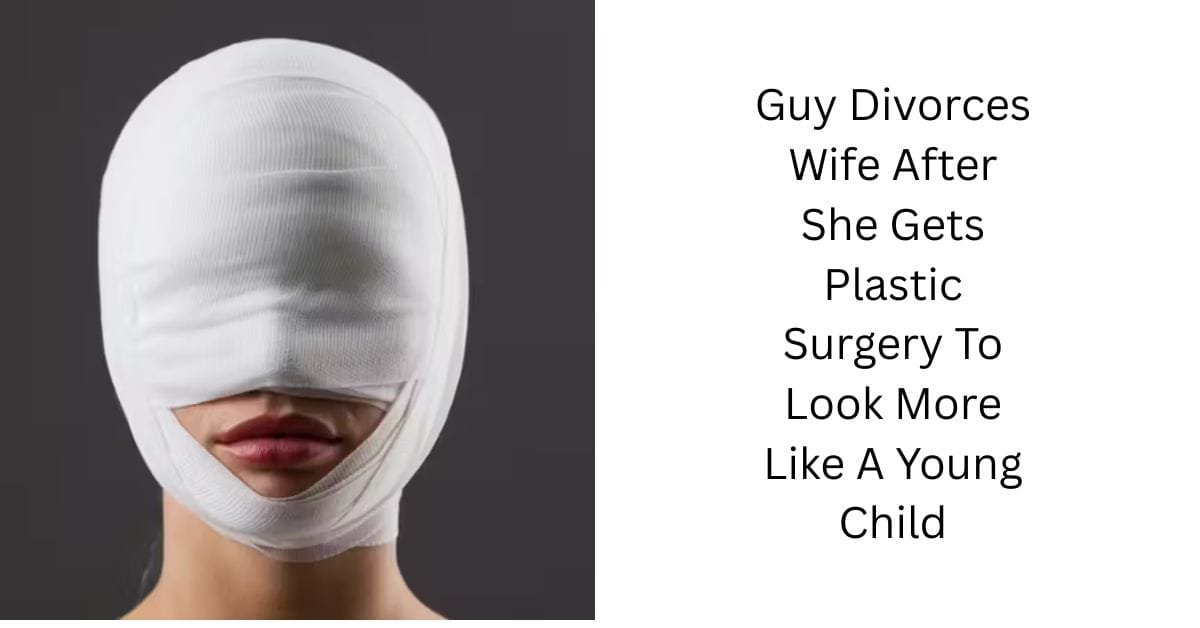
I never expected my marriage to end over plastic surgery, especially because my wife had always been someone who cared about her appearance. When we first met, she enjoyed makeup, fashion, skincare, and occasionally talked about cosmetic procedures, but none of it ever seemed extreme. I always believed that people should be comfortable making their own choices about their bodies, and I never wanted to control what she did with her appearance. We had been married for several years, and although our relationship had its normal disagreements, I never imagined that something related to her looks would eventually make me question whether I could remain married to her. Everything changed when she told me she was considering several cosmetic procedures because she wanted to look much younger. At first, I assumed she meant the kind of changes people make to reduce wrinkles or make themselves look refreshed. Instead, she began talking about wanting a much more dramatic transformation. She showed me pictures of celebrities and influencers with unusually youthful facial features and said she wanted to achieve a similar appearance. I told her I would support her if she was making the decision for herself, but I also admitted that some of the changes made me uncomfortable. She assured me that it was simply about feeling confident and that I had nothing to worry about.
Over the following months, her interest became much more intense. She started researching different surgeons and procedures and spent hours looking at before-and-after pictures online. Eventually, she told me she had found a surgeon who could help her achieve the exact look she wanted. She described wanting a much smaller-looking face, larger-looking eyes, softer facial features, and an overall appearance that would make her look like a very young person. That was the first time I realized this was not simply about looking younger in an ordinary sense. I told her honestly that I did not understand why she wanted to look that way, and I asked her to think carefully before making such a permanent decision. She became defensive and said that I was judging her. According to her, I was only uncomfortable because I was too attached to the way she looked when we first met. I tried to explain that my concern was not about controlling her body. I was worried that she was chasing an appearance that seemed completely different from the woman I had married. She insisted that this was something she had wanted for a long time and that she would regret it forever if she did not go through with it. Eventually, she had the procedures done without changing her mind.
When I saw her after the surgery, I honestly didn’t know how to react. The changes were far more dramatic than I had expected. Her face looked significantly different, and the overall effect was intentionally childlike. She seemed extremely happy with the result and kept telling me that she finally looked the way she had always imagined. She wanted me to compliment her, take pictures with her, and tell her how amazing she looked. I tried to be supportive, but I couldn’t pretend that I felt comfortable. I told her that I was glad she was happy with herself, but I needed time to adjust to the changes. She became angry and accused me of being cruel. She said that if I really loved her, I would accept every part of her appearance without hesitation. The argument became much bigger than the surgery itself. We started discussing how differently we viewed relationships, personal boundaries, and major life decisions. I realized that I wasn’t simply struggling with her new appearance. I was struggling with the fact that she had made such a major permanent decision despite knowing how deeply uncomfortable it made me. She believed marriage meant unconditional acceptance, while I believed both partners should be able to honestly discuss major changes that could affect their relationship.
After that, things between us became increasingly difficult. She started posting pictures of herself online and received a lot of attention from people who liked her unusual appearance. She seemed excited by the reactions and began talking about turning her transformation into part of her online identity. I tried not to criticize her, but I couldn’t hide the fact that I was becoming emotionally distant. We argued about whether my feelings were reasonable. She said I was embarrassed to be seen with her, while I told her that I was struggling to recognize the person I had married. Eventually, we stopped having productive conversations. Every discussion turned into an argument about whether I was accepting enough or whether she was ignoring my feelings. I also began wondering whether I had stayed silent for too long because I was afraid of appearing controlling. The truth was that I had no desire to dictate what she could or couldn’t do with her body. At the same time, I knew I couldn’t force myself to feel attracted to an appearance that made me deeply uncomfortable. After several months of tension, we decided to separate. We tried counseling, but neither of us seemed willing to change our position. She wanted me to accept her transformation completely, while I wanted her to understand that her choices had consequences for our relationship, even if she had every right to make those choices.
Eventually, I made the decision to file for divorce. It was one of the hardest decisions I had ever made because I still cared about her, and I didn’t want the ending of our marriage to become a public fight over who was right or wrong. I told her that I wasn’t divorcing her because she had undergone surgery or because I believed she didn’t have the right to make decisions about her own body. I was leaving because the surgery exposed much deeper differences between us that we could no longer resolve. We had different ideas about compromise, attraction, communication, and what partners owe each other when making major personal decisions. She believed I had abandoned her when she finally became the person she wanted to be. I felt that our relationship had changed into something neither of us recognized anymore. The divorce was painful, but eventually we both accepted that staying married simply because we had once loved each other wasn’t enough. Looking back, I don’t think the surgery alone destroyed our marriage. It was the conflict surrounding it, the inability to understand each other’s perspective, and the realization that we wanted completely different things from the relationship. She has continued embracing her new appearance, while I have been trying to rebuild my life and understand what I should have communicated more clearly from the beginning.
Read Story…
“AITAH for divorcing my wife over her surgeries and decisions?”
The OP watched as his marriage problems quickly escalated.
“I (28 Male) have been married to my wife (27 Female) for four years.”
“Our problems started when she became obsessed with Asians since I’m Asian.”
“She began discussing wanting surgery, and I told her she was perfect the way she was. She eventually got certain surgeries for her eyelids and face area, mostly.”
“But then it got worse when she got more surgery to make herself look like a young child.”
“She’ll go to stores and legit buy toddler-like clothing to make herself seem adorable.”
“She’s gotten into Discord and makes baby sounds, and it’s been concerning.”
The OP tried to talk to his wife about his concerns, but the conversation went nowhere.
“I had a serious talk with her because she kept trying to act like a kid, making spills and not knowing how to clean up when she’s a grown adult.”
“She told me I was being controlling and manipulative about what she liked.”
“I became concerned that it was a kink or a fetish, but she denied it.”
“I also tried to suggest professional help, but it went nowhere. She found it unreasonable and again said I was controlling her and forcing her to seek things she didn’t need.”
“After awhile, I was done, and I divorced her on the spot, because the last time I checked, I don’t like kids or people trying to act like a kid.”
“Her parents attacked me for not supporting her and her friends have, too.”
“AITAH?”
Fellow Redditors weighed in:
- NTA: Not the A**hole
- YTA: You’re the A**hole
- ESH: Everybody Sucks Here
- NAH: No A**holes Here
Despite her denying it, some were certain that the OP’s ex-wife had some kind of fetish.
“NTA. This sounds like somewhere between a kink and a fetish run amok.” – SamSLS
“NTA. Leave. She’s not going to stop, because she’s not getting her ‘little needs’ met.”
“She’s not in a caregiver-little relationship. OP doesn’t want to be her caregiver, and that’s okay, because she probably never discussed it with OP beforehand.”
“Most ‘littlest’ partners I know are upfront about being a ‘little’ with their partner when they started the relationship, and their partner was ready to be the ‘caregiver.'”
“I would have to say, though, that getting surgery for a kink tends to swing toward mental illness of some kind.” – Assignments
“Acting and dressing like a kid alone might be an age regression thing, but paired with the obsession with Asian people and the now Asian fishing gone permanent, I’d absolutely clock it as a fetish or kink, a gross one, but people who fetishize Asian people usually see Asian people as child like, innocent and forever young in body and mind.”
“This is absolutely a stereotypical thing going on anyway. Can’t imagine wanting to dress like a kid, most adult clothes are too big on me, and it feels nasty having to shop in the kids’ section for clothes that actually fit. It doesn’t feel cute or kinky in the slightest.” – Cerberus6669
“I just looked up this kind of relationship dynamic, and this jumped out at me: ‘It is essential that all aspects of the DD/LG dynamic are entered into with enthusiastic consent from both partners.'”
“OP never consented to this. She violated the need for consent. I don’t kink shame either, but consent is absolutely essential.” – OkLingonberry177
“It’s a fetish for sure, but it’s not necessarily a sexual one.”
“This fetish is called age play, where people who, much like your wife, pretend to be child-like or even baby/toddler-like and call themselves littles. I forget what the ones that act like parents are called, but I wouldn’t be surprised if they were called bigs.” – Knives564-alt
“She’s lying. It’s called being a ‘Little’. For some, it’s a kink, but others divorce being a little from sex, ergo it’s not a kink. It is a thing, though, and there is a word for it. It’s not prevalent enough for most people to be aware of what it entails. There are lots of books, fantasy and otherwise, on Amazon about being a little.”
“People have different ages that are their sweet spot, everything from wearing diapers and sucking a binky to being a kid who likes to play with toys to a sexy before her time teen (those who throw off sailor moon vibes in real life). It’s definitely not a mental health issue because some littles are in therapy for different unrelated issues.” – CartoonistFirst5298
Others agreed and said it must be a mental health issue or obsession if it wasn’t a fetish.
“If it’s not a fetish, then it’s a mental health issue. Sorry, OP.” – SnooWords4839
“I mean, if she’s not doing it for kicks, and she can’t stop doing it even when it damages her family and friends, then that sounds like an addiction or mental breakdown to me. Either help her through therapy or get out of there, because she needs to realize this is a problem.” – WaitakereAnimal
“If it’s gotten to the point where it’s hurting the people around her and she still can’t stop, then it’s way deeper than just bad decisions. That’s not something you just brush off.”
“Either she gets real help, or it’s gonna drag everyone down with her. Sometimes tough love is the only way people wake up.” – LongjumpingFox843
“NTA. If it’s not a kink, then it’s a mental health issue and she needs to seek help.” – AimingWang
“It’s not a kink. It’s called ‘age regression.’ My girlfriend is on this spectrum, but it’s very different from how your ex-wife acts. In her case, she also seems to suffer from some dysmorphia, as she had these surgeries.” – BrazilianBratty
“NAH, especially considering her family and friends are supporting her. However, it sounds like a mental health issue. Marriage is supposed to be in sickness and in health.”
“You could try to get her to go to the doctor. If she refuses, then I’d consider that you’re doing what you could to uphold your vows before walking away.” – Anon_Anon_Anon69
Some reassured the OP that he wasn’t wrong to divorce when the dynamic changed.
“You’re not wrong for what you did, OP. It sounds like she stated being different than the person she was when you decided to marry her. Not wanting to be with an adult who acts like a baby seems understandable to me.” – Sensitive-Plan5649
“Maybe it’s still a fetish without the kinky side. You did say she created a discord. Her whole person changed, and that’s just not who you married. I think no one is the jerk in this case. She just changed too much, and you don’t like that. It makes you uncomfortable. NTA.” – LUCiDNiGHTMARE87
“It sounds like you tried to support her at first, but her choices crossed a line that made you deeply uncomfortable, and that’s valid. Wanting a partner, not someone acting like a child, isn’t controlling; it’s a boundary. You’re allowed to leave if the relationship no longer feels healthy or right for you.” – gorgeousmoody
“I’m sorry. Yeah, you need to immediately file for a divorce, and you need to get away. You need to let her family figure out how to deal with her.”
“Enough is too much, and at this point, you’re really doing too much. You’ve put up with this, and I mean okay. She wanted surgery. She’s afraid of looking older. Okay. If she can afford the surgery, that’s fine.”
“She’s buying cutesy clothes that are a little young for her. I would say fine, but you’re telling me it’s not that she’s buying, like, teenager clothes. She’s buying clothes that make her look like a toddler like an overgrown toddler and doing things.”
“A toddler would do like accidentally or accidentally on purpose spilling things and then saying she can’t clean them up because she’s too little. She doesn’t know how.”
“Yeah, she needs a psychiatrist. You need a divorce.” – DMargaretfoodgoddess
“The psychological term for this behavior is paraphilic infantilism, also known as autonepiophilia or adult baby syndrome.”
“This refers to a form of ageplay where an adult derives emotional comfort or sexual gratification from role-playing as a baby or young child. It can include behaviors like wearing diapers, using pacifiers, speaking in baby talk, or engaging in caregiver/little dynamics. Some people do this for non-sexual reasons, like seeking nurturing or stress relief, while for others, it may be part of a sexual fetish.”
“You might need to look into diaper fetishism, which is a separate but related interest focused specifically on diapers, often without the age regression aspect, as well as AB/DL, which is a common umbrella acronym for Adult Baby/Diaper Lover, used in communities that embrace these identities.”
“Importantly, these behaviors are considered part of the spectrum of paraphilias, which are atypical sexual interests. However, they’re not necessarily classified as disorders unless they cause distress or impair functioning.”
“And since this isn’t what you signed on for, you’re NTA!” – 1BellyHamster
While there was no need to shame the ex-wife for what she might be trying to process or what she might in interested in for future relationships, the fact of the matter was that the OP was not informed of this interest when he got into this relationship and marriage, he did not consent to it, and if it was not a relationship dynamic he was interested in, he was not required to stay.
Hopefully, if this was a mental health issue for her and a coping mechanism for something she needed help processing, she’d get the help that she needed.
I Never Thought Plastic Surgery Would End My Marriage
I never expected my marriage to end because of plastic surgery. When my wife and I first met, she cared about her appearance, but she was never obsessed with changing herself. She enjoyed makeup, skincare, fashion, and occasionally talked about cosmetic treatments, but none of it seemed unusual to me. I always believed that everyone had the right to make decisions about their own body. I never wanted to be the kind of husband who told his wife what she could or could not do with her appearance. At the time, I thought that respecting her choices would be enough to keep this issue from ever becoming a serious problem between us.
We had been married for several years, and from the outside, our relationship looked normal. We had gone through the usual arguments that married couples experience, but nothing had ever made me seriously consider divorce. We had built a life together, shared responsibilities, and made plans for the future. I thought I knew my wife very well. That is why I was so surprised when she began talking about wanting a completely different appearance.
At first, she told me that she simply wanted to look younger. I didn’t think much of it because people get cosmetic procedures for all kinds of reasons. She talked about getting rid of some wrinkles and changing certain features that she had never liked about herself. I told her that if it made her feel happier and more confident, then I would support her decision.
However, over time, I realized that she wasn’t talking about simply looking younger. She wanted to create an extremely youthful appearance. She started showing me pictures of women with very large-looking eyes, small facial features, rounded cheeks, and unusually smooth skin. She told me that she wanted to have a similar look. I remember feeling confused because the appearance she was describing seemed much younger than what most adults would consider simply youthful.
I asked her why this particular appearance mattered so much to her. She told me that she had always been fascinated by youthful facial features and believed they made people look cute and innocent. She said she had never felt comfortable with looking older and wanted to preserve a very young appearance for as long as possible. I listened to her, but I still didn’t fully understand why she wanted such a dramatic transformation.
Eventually, she started researching surgeons who specialized in cosmetic procedures. She spent hours looking at photographs, reading reviews, and watching videos about different operations. Her phone seemed to be filled with before-and-after pictures. Whenever we went out for dinner or sat together in the evening, she would often bring up another procedure she had discovered.
I started becoming concerned when she began talking about several procedures at once. She wanted changes to multiple parts of her face rather than making one small adjustment. I told her that she should be extremely careful because some changes could be permanent. She said she understood the risks and had already researched everything.
I tried to make it clear that I wasn’t telling her what she could do. I simply wanted her to understand that such a dramatic change might affect our relationship. I told her that attraction was part of marriage and that pretending otherwise would not be honest. She became upset and said I was making her feel as though my love depended on her appearance.
That wasn’t what I meant. I loved her as my wife, and I didn’t want her to think that I would abandon her over something as simple as aging. But there was a difference between getting a normal cosmetic treatment and intentionally transforming your appearance into something completely different. I didn’t know how to explain that without making her feel judged.
She eventually scheduled the procedures. She told me that she had thought about it carefully and wasn’t going to change her mind. I asked if we could discuss it one more time, but she said she had already made her decision. She believed this was something she needed to do for herself and didn’t want my opinion to influence her.
The day of the surgery was extremely stressful for me. I kept thinking about how different things might be afterward. I knew that I couldn’t stop her, and I didn’t believe I had the right to try. At the same time, I couldn’t shake the feeling that our marriage was entering unfamiliar territory.
When she finally came home after the procedures, I was shocked by how different she looked. The changes were much more noticeable than I had expected. Her face had a significantly younger and more childlike appearance. Her eyes looked larger, her facial structure looked smaller, and her overall appearance was dramatically different from the woman I had known for years.
She was thrilled with the result. She kept looking at herself in the mirror and taking pictures from different angles. She told me that she finally felt beautiful. She said she had never been happier with her appearance and couldn’t understand why I wasn’t celebrating with her.
I tried to compliment her without pretending I felt something I didn’t. I told her that I was glad she was happy and that I knew this had been important to her. But she could tell that I was uncomfortable. She immediately asked me what was wrong.
I finally admitted that the transformation was difficult for me to process. I told her that she looked completely different and that I needed some time to adjust. She became angry and said that I was making her regret sharing the result with me.
The argument quickly became much bigger than the surgery. She accused me of being controlling and said that I wanted her to remain the way she had looked when we first met. I told her that wasn’t true. I had never expected her to stay exactly the same forever. People age, change their hairstyles, gain or lose weight, and make different choices throughout life.
My problem was the specific direction she had chosen. The appearance she wanted was intentionally extremely youthful, and I found that deeply uncomfortable. I didn’t want to insult her, but I also couldn’t force myself to feel differently simply because she wanted me to.
After that conversation, there was a noticeable distance between us. She became more focused on her new appearance and started taking more photographs. She received comments online from people who loved the transformation, and those reactions seemed to make her even more confident about her decision.
She began talking about creating social media content around her new look. She wanted to show people her transformation and discuss the procedures she had undergone. I didn’t want to interfere with that because it was her life, but I started realizing that our priorities had changed.
She believed I should be proud of her for becoming more confident. I believed I should be allowed to honestly say that I wasn’t comfortable with the changes. Neither of us seemed able to understand the other’s position. Every conversation eventually became an argument about acceptance.
At one point, she told me that if I really loved her, her appearance shouldn’t matter. That statement stayed with me because I understood what she was trying to say, but I didn’t agree with it. Physical attraction isn’t the only part of a marriage, but it can still be an important part of a romantic relationship. I didn’t think either of us should have to lie about our feelings.
We eventually tried marriage counseling. I hoped that a therapist could help us talk about the situation without constantly blaming each other. During the sessions, it became clear that the surgery was only part of the problem. We had very different ideas about personal freedom, compromise, attraction, and how major decisions should be handled in a marriage.
My wife believed that her body belonged entirely to her and that I had no right to expect her appearance to remain familiar to me. I agreed that she had the right to make decisions about her own body. But I also believed that I had the right to decide what I was comfortable with in a marriage and whether the relationship still worked for me.
The counseling helped us understand each other somewhat, but it didn’t change how we felt. She didn’t regret the surgery, and I didn’t suddenly become comfortable with the transformation. Eventually, we both realized that continuing to argue wasn’t going to solve anything.
I made the painful decision to file for divorce. I knew people would probably assume that I was shallow or controlling because the situation involved my wife’s appearance. But from my perspective, the divorce wasn’t about punishing her for getting surgery. She had the right to make that choice, and I had the right to decide whether I could continue in the marriage afterward.
The divorce was painful for both of us. There was no dramatic betrayal or single moment where everything suddenly collapsed. Instead, the surgery revealed differences that had probably been underneath our relationship for a long time. We simply hadn’t noticed them because we had never been forced to confront them.
My wife continued to embrace her new appearance after the separation. She seemed genuinely happier and more confident, and I didn’t want to take that away from her. Even though I couldn’t accept the changes within our marriage, I understood that she had made them because she wanted to feel comfortable with herself.
Looking back, I don’t believe either of us completely understood what would happen when she decided to change her appearance so dramatically. She wanted freedom to become the person she imagined herself being, while I wanted my feelings about the transformation to be respected. Neither of us was willing to give up what mattered most to us.
In the end, I don’t think the plastic surgery alone destroyed our marriage. The real problem was that we discovered we had very different expectations about marriage and personal choices. She wanted complete independence over her appearance, while I realized that I couldn’t remain in a relationship where I felt uncomfortable with such a fundamental change.
Divorce was never something I imagined when we first got married. I still remember the person I fell in love with and the life we built together. But sometimes a relationship changes in ways neither person expected. We can respect someone’s right to make their own choices while also recognizing that those choices may change the relationship. I don’t hate my former wife, and I don’t believe she was wrong for wanting to change herself. I simply realized that I could no longer continue the marriage after the transformation, and eventually, we both had to accept that our lives were going in different directions.