“My Husband Keeps Choosing Golf Over His Sick Wife—Am I Wrong to Be Furious?”
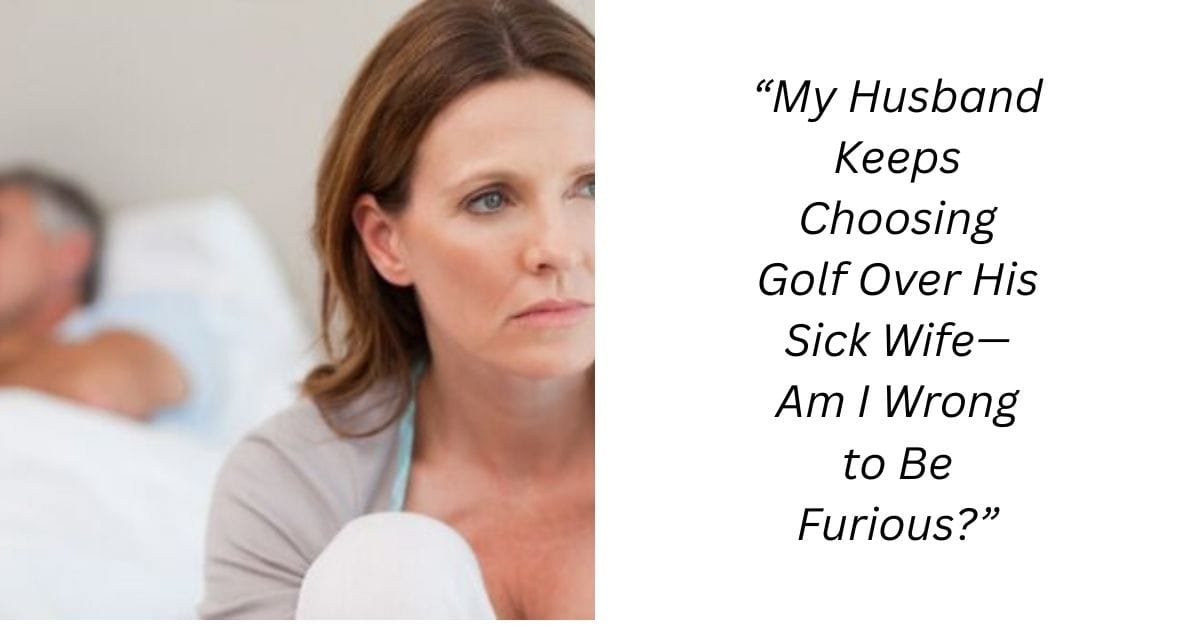
I never imagined that being sick would make me question my entire marriage. My husband and I have been married for almost fifteen years, and for most of that time, I genuinely believed we were a team. We have been through job changes, financial struggles, family problems, and all the ordinary ups and downs that come with building a life together. Whenever he needed me, I tried to be there without making him feel guilty for asking. That is why his behavior now hurts so much. Over the past several months, I have been dealing with a health problem that has left me exhausted and unable to do many of the things I normally handle around the house. Some days are manageable, while other days I barely have enough energy to get out of bed. I don’t expect my husband to become my full-time caretaker, and I have never asked him to give up his entire life because I’m sick. I know he needs hobbies, friends, and time for himself. The problem is that when I genuinely need his help, he often seems more concerned about whether he will miss his weekly golf game than whether I am okay. At first, I tried to understand it. Eventually, though, I started feeling like his golf schedule was more important to him than his wife.
My husband has always loved golf. Even before I became sick, he would usually play once or twice a week, and I never had a problem with it. I actually encouraged him to have something he enjoyed. I knew he worked hard, and I understood that spending a few hours on the golf course helped him relax. I never wanted to be the wife who demanded that her husband give up every hobby after marriage. The situation changed when my health began getting worse. There were mornings when I needed help getting ready, making food, or simply getting around the house, and he would still be talking about his tee time. One weekend, I had been feeling particularly awful and asked him if he could stay home because I wasn’t sure how I would manage by myself. He told me that he had already made plans with his friends and that I should call someone else if I needed help. I was stunned. I reminded him that I wasn’t asking him to cancel every golf game forever. I was asking him to stay home on one particular day because I was genuinely struggling. He eventually stayed, but he acted irritated the entire morning. That was the moment I realized the issue wasn’t really golf. It was the feeling that being there for me had become an inconvenience.
A few weeks later, I had one of my worst days physically. I was exhausted, in significant discomfort, and couldn’t manage many basic tasks around the house. My husband had a golf game scheduled that afternoon. I told him honestly that I was scared to be alone because I wasn’t sure how I would feel later. Instead of asking what I needed, he immediately started explaining how important this particular game was. His friends had arranged it weeks in advance, and apparently canceling would disappoint them. I asked him whether disappointing his friends was really more important than staying with his sick wife. He became defensive and told me I was making him feel guilty for having a life. That completely broke something inside me. I told him that I wasn’t angry because he played golf. I was angry because he seemed to care more about missing golf than about how vulnerable I felt. The argument became much bigger than either of us expected. He accused me of becoming dependent on him and said that he couldn’t put his entire life on hold because I was sick. I told him I had never asked him to put his entire life on hold. I simply wanted my husband to recognize that there are moments in a marriage when one person’s needs have to come before a hobby.
After the argument, I started questioning myself. Maybe I was being unreasonable. Maybe I had become so focused on my illness that I wasn’t considering what my husband was going through. Being a caregiver, even temporarily, can be exhausting. He may be scared too. He may be dealing with stress that he doesn’t know how to express. Maybe golf is his way of escaping the anxiety surrounding my health. I tried to look at things from his perspective, but I couldn’t escape one simple feeling: I didn’t feel supported. There were several small moments that kept replaying in my mind. He would ask whether I needed anything before leaving for golf, but if I said yes, he would sigh as though I had ruined his plans. He would come home and talk excitedly about his score while barely asking how I had spent the day. Sometimes he would tell me about plans for the following weekend without even checking whether I had appointments or needed help. None of these things seemed huge individually, but together they made me feel invisible. I didn’t want constant attention or sympathy. I wanted partnership. I wanted to know that when life became difficult, my husband would willingly stand beside me instead of making me feel guilty for needing him.
The hardest part is that I still love my husband. This isn’t a story where he suddenly became a terrible person and I stopped caring about him. There are many good things about our marriage, and I don’t want one painful period to erase fifteen years of memories. But sickness has changed the way I look at our relationship. Before, I could overlook certain differences because life was easier. Now that I am vulnerable, I need to know whether I can depend on the person I married. I don’t expect him to abandon his hobbies, friendships, or personal life. I don’t even expect him to be beside me every minute of every day. But I do expect him to recognize when I genuinely need him and willingly make sacrifices when the situation calls for it. Golf can wait. Friends can reschedule. A hobby can be picked up again next weekend. But when your spouse is sick and frightened, you don’t always get those moments back. I’ve told him that I don’t want to control his life; I want to feel like I’m still part of his priorities. Now we’re at a point where he says he understands, but I’m not sure whether understanding the words is enough. I need to see a change in his actions. I’m left wondering whether I’m wrong to be furious about his golf games, or whether the anger I’m feeling is really about something much deeper: the fear that when I needed my husband the most, I discovered that I couldn’t count on him.
Read Story…
“My Husband is Choosing Golf Over His Sick Wife”
I am 55 and have been married for 36 years. I have many chronic illnesses which have put a strain on my marriage. My husband, with a group of guys he has played golf with for over 20 years, has an annual trip out of town coming up. I have post-menopausal spotting and my doctor has decided to schedule surgery to rule out cancer. I was given two dates, and one is the last day of the golf trip. The other is at the end of the month. I chose the first date as I am a little worried this is cancer.
My husband will not cut his trip short as they play a “tournament,” so my sister is taking off work to take me. I am extremely hurt and angry. He says that if it were cancer, they’d have scheduled the surgery right away. This is not the first time he has chosen golf over me. This is the most critical time. I don’t know if I should leave him or not. He used to have a drinking problem, where he would lash out at me and say hurtful things. He hasn’t done that recently, but now he is gambling. I feel hopeless. — Left for Golf
Honestly, I think the alcohol problem, the lashing out at you saying hurtful things, and now the gambling are far worse offenses than his not cutting short an annual trip with his friends to take you to surgery when you have a sister who can take you and you could have chosen a different day for the surgery that isn’t a schedule conflict. If you have many chronic illnesses, your husband has probably felt a lot of strain over the years supporting you and I would bet this annual golf trip is something he really looks forward to to relieve stress and decompress a bit.
I would also bet he is not a stranger to your worrying that you have cancer. I don’t say that to dismiss your fear, and maybe I’m wrong and this is the first time you’re facing such a worry, but if you have a history of chronic illnesses, logically it would make sense that your husband has been through a lot of diagnostic tests and procedures with you and it’s ok if this one time your sister is by your side instead. If you get results right away and the news is bad, you’ll still have a strong support system with you and your husband will be there within 24 hours.
As for leaving your husband, I wouldn’t do so over this one offense, but if your husband has a history of blowing off what you consider important events and is generally unsupportive, then it’s probably time to consider whether you would be happier without him in your life. As I said earlier, the drinking problem and the lashing out at you, and now gambling, seem like bigger offenses. But they are all behaviors that can be addressed with counseling (both individual and couples counseling), which is definitely something I recommend if you’re to have any hope to get this marriage on a happier, more functional track.
I am a junior in college and have been single for well over a year now without any real issues. I’ve always been fairly picky and just hadn’t found a guy that I really clicked with. A little over a month ago, I found my “unicorn” of sorts. I met him in class my freshman year when we were both in other relationships. We have recently re-connected and honestly it has been a whirlwind, and it’s been great. All of my friends love him, and he genuinely enjoys spending time with them and me! I’ve met and become close with many of his friends and even some of his family. We have had the “exclusivity” talk — something that he brought up first.
This is honestly my dream man: smart, driven, kind, and passionate. I am bringing him home to meet my family this weekend and he seems genuinely excited about it, which makes me giddy. Theres one thing — the other day we were sitting together and he was showing me something on his phone when I noticed that his ex-girlfriend is his #1 best friend on snapchat! He’s talked about her before and how their relationship was toxic and how he was really hurt by the whole situation. I had no idea they still talked, and I don’t know how to bring it up without sounding like a crazy person that is stalking his phone. Help!! — “Crazy” For My Unicorn
Look, there’s nothing “crazy” about being interested in the friendships of someone you’re newly dating or seeking clarification over what seems like contradicting personal information. And if you’re ever with someone who makes you feel you’re “crazy” for seeking clarification – either by insinuating or explicitly stating so, consider that a great big red flag. What I would do if I were you is to say to this guy, without an accusatory tone: “Hey, the other day when you were showing me something on your phone, I noticed that your ex was your best friend on snapchat. I was surprised since you’d mentioned how toxic your relationship had been and how hurt you were by the situation. I’ve met so many of your friends and family now, but I wasn’t even aware she was still in your life, so it felt confusing.” And then see what his response is. Again, if he makes you feel crazy for bringing this up, consider that a red flag.
Something that gives me pause about your situation is that you only re-connected with this guy just over a month ago and you’re already saying that you’ve “met and become close with many of his friends and even some of his family.” Really? After a month of reconnecting with him, you’re already close with some of his friends and family? It takes time to build up a closeness with someone, let alone someone’s friends and family. It takes time to get to know someone — not just all these wonderful “unicorn” traits, but the flaws, too.
When you set someone up on a pedestal right out of the gate, he’s going to fall off because perfection isn’t sustainable. And you can’t create an insta-relationship in a matter of weeks either. What you can do in a few weeks is start to build a foundation, which is the phase you’re in. Learning more about his personal history and the people in his life who are important to him will hopefully strengthen your foundation, but if he acts shady about any parts of his personal history that potentially affect your relationship, take heed of the warning and proceed with caution.
I Never Thought Being Sick Would Change My Marriage
I never imagined that getting sick would make me question the marriage I had spent so many years building. My husband and I have been together for a long time, and for most of our marriage, I believed we understood what it meant to be a team. We had gone through difficult financial periods, stressful family situations, career changes, and all the ordinary problems that come with sharing a life with another person. Whenever he needed support, I tried to give it without making him feel like a burden. When he was overwhelmed, I listened. When he had a difficult week at work, I tried to make home easier for him. I never expected some kind of perfect marriage where neither person would ever be inconvenienced by the other. I understood that relationships require compromise. But recently, my health has become a major issue, and instead of feeling closer to my husband during this difficult period, I feel more alone than I ever have before. The problem isn’t simply that he plays golf. The problem is that even when I’m genuinely struggling, golf seems to remain one of his highest priorities.
My husband has always loved golf, and honestly, I never had a problem with it. Golf has been part of his life since before we met. He usually plays with the same group of friends, and it has always been his way of relaxing after a stressful week. I encouraged him to keep that hobby because I believe people should have interests outside their marriage. I have never been the type of wife who thinks marriage means spending every waking moment together. If he wanted to spend Saturday morning playing golf while I went shopping, visited family, or relaxed at home, I didn’t care. The problem started when my health deteriorated and I began needing more help. Suddenly, the same golf games that had once seemed harmless started becoming a source of resentment. There were days when I was exhausted and barely able to handle basic household tasks, yet he would still be preparing his golf bag and checking the weather forecast. I didn’t expect him to quit forever. I expected him to recognize that circumstances had changed and that his wife sometimes needed him more than she used to.
My illness hasn’t necessarily made me completely helpless, but it has made ordinary activities much harder than they used to be. Some mornings I wake up feeling reasonably okay, while other days I struggle just to get out of bed. Things like cooking, cleaning, grocery shopping, and keeping up with normal household responsibilities can leave me completely exhausted. There are also appointments, medications, tests, and other things that have made life more complicated. The hardest part is not knowing how I’ll feel from one day to the next. Sometimes I make plans thinking I’ll be fine, only to wake up the next morning unable to follow through. I’ve tried to remain as independent as possible because I don’t want my husband to feel like everything has suddenly become his responsibility. I still do what I can, and I ask for help only when I genuinely need it. That’s why it hurts when I ask him to stay home or help me with something important and his first response is to mention his golf plans. It makes me feel as though I’m competing with a hobby for my own husband’s attention.
The first time I specifically asked him to skip golf because I was sick, I tried very hard to make it sound reasonable. I didn’t demand it. I didn’t yell. I simply told him that I was having a particularly difficult day and didn’t feel comfortable being alone for several hours. I asked if he could stay home that morning. He looked disappointed and immediately reminded me that he had arranged the game with his friends weeks earlier. I told him I understood, but I was asking because I genuinely needed him. His response was that I could call a family member if something happened. That sentence stayed with me. I wasn’t asking whether someone else could technically help me. I was asking whether my husband wanted to be there for me. There was a huge difference between those two questions. He eventually stayed home, but he spent much of the morning visibly irritated. He checked his phone repeatedly, looked at the time, and mentioned how much he was missing. Instead of feeling cared for, I felt guilty for asking him to stay.
After that day, I became much more hesitant to ask for help. I started thinking twice before telling him when I wasn’t feeling well because I didn’t want another argument. If I mentioned that I was tired, he would sometimes ask whether I needed something, but there was often an impatient tone behind the question. If the answer involved him changing his plans, I could immediately see his mood change. Eventually, I began doing things myself even when I probably shouldn’t have. I would cook when I was exhausted, carry things that were too heavy, or push myself through household chores because I didn’t want to hear that I was preventing him from doing something he enjoyed. I know that isn’t healthy, but I didn’t want to become the wife who constantly complained about being sick. I wanted him to understand my needs without me having to repeatedly beg. Instead, I found myself becoming quieter and more independent at exactly the time when I probably needed to allow myself to be vulnerable.
One weekend, my condition was particularly bad. I had barely slept the night before and woke up feeling weak and miserable. My husband had a golf tournament planned with his friends. It wasn’t just a casual game he could easily leave early; they had apparently been looking forward to it for weeks. I understood that, but I also knew I wasn’t doing well. I told him I was worried about being alone and asked whether he could cancel. He immediately became frustrated. He said I knew how important the tournament was to him and accused me of making every problem about myself. I was stunned. I wasn’t trying to make anything about myself. I was literally telling my husband that I wasn’t feeling safe being alone. He said I was asking him to put his life on hold because of my illness. I told him that I wasn’t asking him to put his life on hold. I was asking him to make one sacrifice for his wife. Somehow that became a huge argument, and by the end of it, I was crying while he was telling me that I needed to be more understanding.
After he eventually left for golf, I sat alone and thought about everything he had said. I kept replaying the phrase “put my life on hold.” Was that really how he saw supporting me? Was my illness something he considered an interruption to his normal life? I wasn’t asking him to stop seeing friends, stop working, or stop enjoying himself. I wanted him to understand that there would be periods in a marriage when one person’s needs temporarily become more important than the other’s hobbies. If he were the one who was sick, I know I would rearrange my plans for him. I wouldn’t even think twice about it. I would want to make sure he was okay. I would probably cancel things without him asking because I wouldn’t want him sitting alone and scared. Realizing that made me feel even more hurt. It wasn’t simply that he chose golf. It was that I couldn’t imagine making the same choice if our positions were reversed.
I never intentionally decided to keep score, but eventually I began remembering every time he chose golf over something involving me. There was the appointment he couldn’t drive me to because he had a game scheduled. There was the weekend when I needed help around the house but he spent most of Saturday on the course. There was another evening when I wasn’t feeling well and he left to meet his golf friends for dinner afterward. None of these incidents seemed catastrophic by themselves. If someone told me about one of them, I might say that couples need individual lives and that one evening doesn’t define a marriage. But when you put all of them together, they start telling a different story. I began wondering whether I had become the person who was expected to adjust while he continued living almost exactly as he had before I became sick. My life had changed dramatically because of my health. His life seemed to have changed only when my needs became impossible to ignore.
My husband eventually explained that golf is how he copes with the stress of my illness. He said that he spends so much time worrying about me that being on the golf course gives him a few hours where he doesn’t have to think about doctors, appointments, medications, and everything else. I can understand that. I really can. I know my illness affects him too, even if I’m the person experiencing the physical symptoms. He has his own fear, frustration, and uncertainty. I don’t want to dismiss that. But I told him that coping with stress cannot mean abandoning the person who is sick. There has to be a balance. He can have his golf games, but I need to know that when I genuinely need him, he’ll prioritize me. His response was that I was making him feel guilty for doing something that helped him emotionally. I told him that wasn’t my intention. I simply wanted his coping mechanism to exist alongside his responsibilities as a husband rather than replacing them.
One thing I need to make clear is that I don’t want to control my husband’s schedule. I don’t want to become the wife who checks his calendar and decides which activities he’s allowed to attend. I would hate that kind of relationship. He deserves time with his friends. He deserves hobbies. He deserves moments when he isn’t thinking about my health. But there is a difference between reasonable independence and refusing to make sacrifices when your spouse genuinely needs you. If I were asking him to cancel golf every weekend, I could understand his frustration. If I demanded that he never see his friends again, I would understand why he felt trapped. But that’s not what I’m doing. I’m asking him to occasionally choose me when the situation is serious. I don’t think marriage should be about keeping two completely separate lives that only overlap when everything is convenient. Sometimes marriage means doing things you don’t want to do because the person you love needs you.
My family has noticed that I’m struggling more than I let my husband know. My sister asked me recently why she seemed to be helping me more than my husband was. I didn’t know how to answer without making him sound terrible. I defended him at first and said that he was working and dealing with stress too. She didn’t argue with me, but she pointed out that whenever I needed something, she was the one I called because I already knew my husband would probably be busy. That hit me harder than I expected. I realized that I had unconsciously created a backup system because I didn’t trust my husband to be available. That’s not how I thought marriage would feel after so many years. I should be able to call my husband when I’m scared or sick without wondering whether I’m interrupting something more important. My sister told me that I wasn’t asking for too much, but I still wasn’t completely convinced. I kept wondering whether I was simply too emotional because of everything I was going through.
My husband has accused me of becoming too dependent on him since my health problems started. He says that before I became sick, I was independent and handled everything myself, and now he feels like the expectations placed on him have changed overnight. I can understand why that might scare him. I don’t want to lose my independence either. But needing help during an illness doesn’t mean I’ve suddenly become incapable of taking care of myself. Sometimes people who are normally strong still need support. I told him that I wasn’t asking him to do everything for me. I simply wanted him to participate more when I was having difficult days. He said that if he starts canceling everything whenever I feel bad, eventually he’ll have no life of his own. I told him that wasn’t what I wanted. What I wanted was for him to learn the difference between a normal difficult day that I can handle myself and a serious day when I genuinely need him. Somehow, we still haven’t figured out how to communicate that distinction without arguing.
There is another part of this that I don’t talk about very often. I’m scared. Being sick isn’t only physically exhausting. It’s emotionally exhausting too. There are days when I wonder what my future will look like and whether my health will improve. I worry about becoming a burden. I worry about losing the independence I worked hard to maintain. I worry about how my illness might affect our marriage. Sometimes I don’t even need my husband to solve anything. I just need him to sit beside me and tell me that we’ll figure things out together. Instead, when he leaves for golf, I sometimes sit alone with all those thoughts. I don’t think he understands that his absence feels bigger than simply being gone for four hours. It can feel like confirmation of my worst fear—that when life becomes difficult, I will have to face it mostly by myself.
During one argument, my husband told me that I was turning golf into the villain in our marriage. He said the real issue was communication and that golf was simply an easy target because I already felt vulnerable. That statement actually made me think. Maybe he’s partly right. Maybe if golf didn’t exist, we would be arguing about something else. The deeper issue could be that I don’t feel emotionally supported. Golf has simply become the symbol of everything I feel I’m losing. Before I became sick, I saw golf as his hobby. Now, when I see his clubs by the door, I sometimes feel anxious because I know there may be another moment when I need him and he’ll choose to leave. I don’t hate golf. I hate what it represents to me now. It represents the possibility that his life can continue normally while mine has been completely disrupted.
Eventually, I suggested that we create some kind of compromise. I told him I didn’t want to stop him from playing golf. Instead, I suggested that we agree on certain situations where he would stay home if I genuinely needed him. If I had an important medical appointment, was having an unusually bad health day, or was feeling unsafe alone, those would be times when family responsibilities would come first. On ordinary days, he could play without feeling guilty. I thought this was reasonable. He agreed in theory, but the problem was determining what counted as a genuinely serious day. He sometimes believed I could manage when I knew I couldn’t. I told him that he needed to trust me when I said I wasn’t okay. If I’m normally independent and specifically tell him that I need help, there is usually a reason. I don’t want to exaggerate my condition just to keep him home. I want him to believe me.
Before all this happened, I never questioned whether my husband and I were a team. We divided responsibilities based on what each of us was good at. Sometimes I handled things he didn’t want to deal with, and other times he took care of things I found difficult. We supported each other’s careers and personal goals. If one of us had a bad week, the other usually stepped in. That’s why this situation has been so shocking. It’s not just about his current behavior. It’s about the contrast between the husband I thought I married and the person I’m experiencing now. Maybe he’s overwhelmed. Maybe he’s scared. Maybe he doesn’t know how to handle seeing me sick. But whatever the reason, the result is that I feel abandoned during one of the most vulnerable periods of my life. I don’t know whether this is a temporary failure that we can repair or whether my illness has revealed something about our marriage that was always there.
At the same time, I know my husband is human. He isn’t a machine designed to take care of me twenty-four hours a day. He has emotions too. He may be grieving the life we had before my health problems. He may be afraid of what the future holds. He may use golf to escape because he doesn’t know another way to deal with everything. I don’t want to punish him for feeling overwhelmed. I also don’t want him to feel like he has to pretend everything is fine. I would rather he tell me honestly that he’s struggling than disappear behind his hobby. If he needs support, I want to know. If he needs counseling, I would support that. If he needs an occasional weekend away, I could probably understand that too. But he needs to communicate those needs instead of simply leaving whenever things become uncomfortable. I think we are both hurting, but we’re expressing that hurt in completely different ways.
The strangest thing is that sometimes the emotional loneliness hurts more than the physical symptoms. When I’m physically sick but surrounded by people who care about me, I can usually handle it. When I’m physically sick and feel emotionally abandoned, everything becomes heavier. I start questioning whether I matter. I start wondering whether I’m being unreasonable. I start thinking that maybe I should stop asking for anything at all. That isn’t a healthy place to be. I don’t want my marriage to teach me that needing someone is shameful. I spent years believing that marriage meant having a person who would stand beside me when life became difficult. Now I’m learning that people can love each other and still fail each other in important ways. I don’t know whether my husband understands how deeply this is affecting me. Every time he chooses golf during a moment when I need him, another small piece of trust seems to disappear.
During one particularly emotional conversation, my husband finally admitted something I hadn’t expected. He said he doesn’t know how to handle seeing me sick. He told me that before all this happened, he felt capable of fixing problems. If something broke, he could repair it. If we had financial trouble, he could work harder. If there was a family problem, he could try to solve it. But my health isn’t something he can simply fix. He said golf gives him a place where things are simple. He knows the rules, understands what he’s doing, and can measure whether he’s improving. At home, he feels helpless. Hearing that made me feel more compassionate toward him. For the first time, I understood that maybe his behavior wasn’t entirely about not caring. Maybe he was running away from his own fear. But understanding why he behaves this way doesn’t automatically make the behavior okay. I still need him to find a healthier way to cope.
I told my husband that I don’t need him to fix my illness. I know he can’t. Doctors are handling the medical side, and I’m doing everything I can to manage my health. What I need from him is emotional support. I need him to sit beside me sometimes without trying to solve anything. I need him to ask how I’m feeling and actually listen to the answer. I need him to recognize when I’m having a difficult day and sometimes choose to stay home. I need him to remind me that I’m still his wife and not just a problem he has to manage. I told him that he doesn’t have to have all the answers. He just has to show up. That seemed to affect him more than my previous arguments had. He apologized and said he hadn’t realized how much his absence was hurting me. But apologies are easy when emotions are high. What matters now is whether his behavior changes when the next golf invitation comes.
A few days later, another difficult situation came up. I wasn’t feeling well, and my husband had another golf game scheduled. This time, he asked me directly whether I needed him to stay. I was almost shocked that he asked instead of simply announcing that he was leaving. I told him honestly that I wasn’t sure. I could probably manage physically, but emotionally I didn’t want to be alone. He thought for a moment and decided to stay. He didn’t make a big speech about it. He simply put his golf bag away and made lunch for both of us. We spent the afternoon watching television and talking. It wasn’t some dramatic romantic gesture, but it meant more to me than he probably realized. For once, I didn’t feel like I had to compete with something. I felt like he had chosen to be there because he wanted to be there.
Even though that day was meaningful, I don’t want to pretend everything suddenly became perfect. Trust doesn’t come back instantly. When you’ve spent months feeling like a burden, one good afternoon doesn’t erase all the previous moments. I still sometimes feel anxious when he mentions golf. Part of me immediately wonders whether he’s going to choose it over me again. I hate feeling that way because I don’t want to become suspicious or controlling. I want to trust him. But rebuilding trust takes time. He has also told me that he feels like he’s constantly being evaluated now, which makes him nervous. I told him I don’t want that either. I don’t want to sit there waiting for him to fail. I want to reach a point where I naturally believe he will show up when I need him. We’re not there yet, but at least we’re finally talking about the real problem instead of arguing about golf.
I’ve realized that I have things to work on too. Because I’m sick and scared, I’ve sometimes expected my husband to understand exactly what I need without me explaining it. I’ve assumed that if he loved me, he would automatically know when I needed emotional support. That’s not always fair. People aren’t mind readers. I’ve started being more direct about what I need instead of expecting him to guess. I’ve also encouraged him to continue seeing his friends and playing golf when I’m doing okay. I don’t want resentment to build because he feels trapped. If we are going to survive this, we both need room to be honest. He needs to tell me when he’s overwhelmed, and I need to tell him when I’m genuinely struggling. Neither of us can continue communicating through anger, guilt, or silence.
Even after everything we’ve discussed, I’m still angry. Sometimes I look back at the days when I was struggling alone while he was out playing golf, and I feel a deep sense of betrayal. Maybe part of me wants him to understand how much those moments hurt me. Another part of me knows that staying angry forever won’t help our marriage. I don’t want to punish him indefinitely for mistakes he is trying to correct. But I also don’t think I should simply forget everything because he apologized. My anger is telling me that something important was missing. Maybe it was support. Maybe it was communication. Maybe it was empathy. Whatever it was, I need to know that it won’t happen again. I don’t think I’m wrong for being furious. But I also don’t want my anger to become the only thing left between us.
That’s where I am now. My husband still loves golf, and I don’t want to take that away from him. I also still love my husband, despite everything that has happened. But my illness has forced both of us to confront what marriage actually means when life stops being convenient. I don’t need a husband who gives up every hobby, cancels every plan, and spends every second taking care of me. I need a husband who understands that sometimes life requires sacrifice. I need to know that when I’m genuinely vulnerable, he won’t make me feel guilty for needing him. Maybe golf was never really the problem. Maybe it simply exposed a deeper problem in our marriage that we had never been forced to confront. I don’t know what the future holds for my health or my marriage, but I do know that I can’t go back to pretending everything is fine. I need partnership, compassion, and the reassurance that I’m not facing this alone. So, am I wrong to be furious that my husband keeps choosing golf over his sick wife? Maybe the anger is justified—but now I have to decide whether he is willing to turn that understanding into lasting change.



One thought on ““My Husband Keeps Choosing Golf Over His Sick Wife—Am I Wrong to Be Furious?””
Comments are closed.