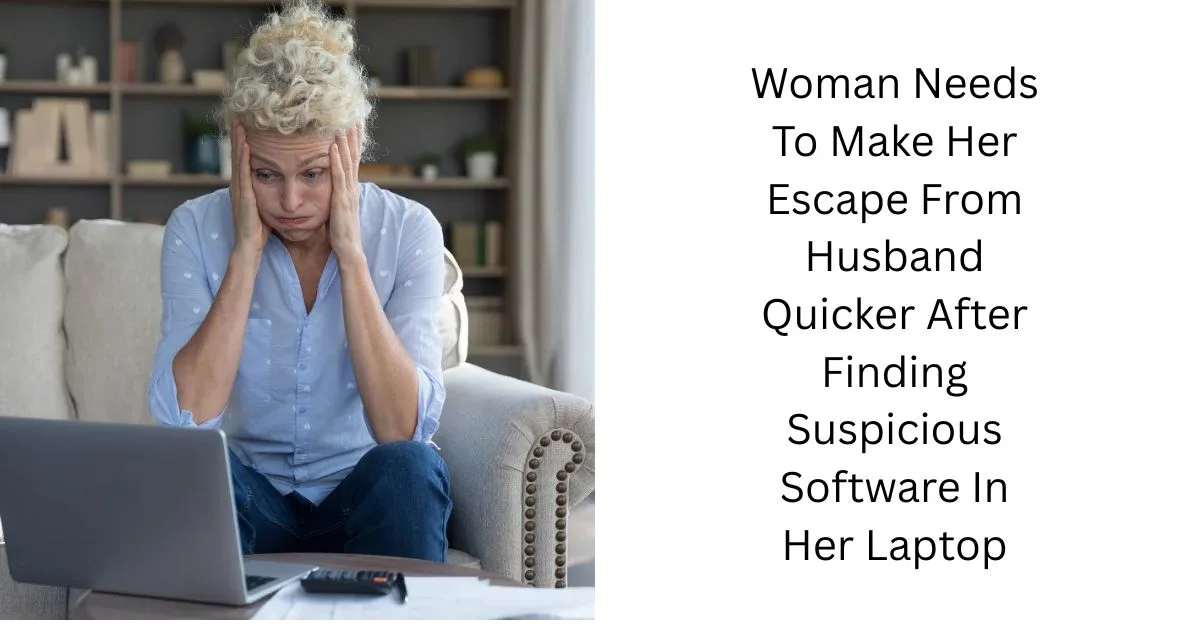
Woman Needs To Make Her Escape From Husband Quicker After Finding Suspicious Software In Her Laptop
I never expected something as ordinary as checking my laptop to make me question whether I was actually safe in my own marriage. My husband and I had been together for several years, and from the outside, our relationship looked normal. We had the usual disagreements, but I never thought of him as someone who would deliberately invade my privacy or monitor me. One afternoon, my laptop started behaving strangely. It was slower than usual, certain settings had changed, and I noticed a program running in the background that I didn’t recognize. At first, I assumed it was some kind of legitimate software that had been installed during an update. But when I searched for information about it, I became uncomfortable. The program appeared to have capabilities that could potentially monitor activity on the computer. I immediately started wondering how it had gotten there because I hadn’t installed anything like it.
I asked my husband about the software, expecting him to give me a simple explanation. Instead, his reaction made me more suspicious. He became defensive and asked why I was looking through the computer settings in the first place. When I told him I had discovered an unfamiliar monitoring program, he initially claimed he didn’t know what I was talking about. Later, however, he admitted that he had installed some software on the laptop because he was “concerned” about what I was doing online. He tried to make it sound harmless, saying that couples shouldn’t have secrets and that he only wanted to know who I was talking to. The more questions I asked, the more uncomfortable I became. He wanted to know who I emailed, what websites I visited, and whether I had been communicating with certain people. I realized this wasn’t about protecting the laptop or fixing a technical problem. It was about controlling my private life.
What frightened me most was discovering that the software might not have been the only thing he knew about. Once I started thinking about previous conversations, several strange incidents suddenly made sense. He had occasionally mentioned details about messages I had received without me telling him about them. He knew when I had been online, even when I hadn’t mentioned using my laptop. There had been times when he seemed to know where I had been or who I had spoken to, and I had always assumed he was simply paying attention. Now I wondered whether he had been monitoring me for much longer than I realized. I also remembered how often he questioned me about small changes in my routine. At the time, I had interpreted it as jealousy or insecurity. Looking back, it felt much more deliberate. I began to understand that I might have been living with someone who wanted access to every part of my life without my permission.
I didn’t confront him again immediately. Instead, I started thinking carefully about how to protect myself and leave safely. I knew that if he had been willing to install monitoring software without telling me, I couldn’t assume that my other devices or accounts were private either. I used a device I believed he couldn’t access to contact someone I trusted and explain what was happening. I also began making plans without telling my husband exactly what I intended to do. I gathered important documents, made sure I had access to my own money, changed important passwords from a safer device, and considered where I could stay if I needed to leave quickly. The hardest part was accepting that the person I had trusted for years might react badly if he realized I was preparing to leave. I kept questioning myself and wondering whether I was overreacting, but then I would remember the software and how deliberately he had hidden it from me. That was enough to remind me that my privacy and safety mattered more than avoiding an uncomfortable confrontation.
Eventually, I decided that I needed to get out rather than spend more time trying to convince myself that everything was fine. The discovery of the software had changed the way I saw our entire relationship. What I once considered normal jealousy now looked like a pattern of surveillance and control. I realized that I had spent too much time trying to explain away behavior that should have concerned me much earlier. Leaving wasn’t simple, and I knew there could be practical and emotional consequences, but staying simply because I was afraid of what might happen next didn’t feel safe either. I made arrangements with people I trusted and focused on getting somewhere secure before discussing the marriage further. Looking back, I wish I had recognized the warning signs sooner. Finding that suspicious software didn’t just expose what my husband had been doing on my laptop; it forced me to recognize how much control he had gradually tried to gain over my life. The biggest lesson I took from it was that privacy isn’t something a spouse is entitled to take away just because you’re married, and sometimes discovering one disturbing detail is enough to show you that leaving sooner may be the safest decision.
Read Story…
I (43F) have been quietly planning to leave my husband (45M). Now I found remote access software on my laptop and I am scared.
My husband (45M) and I (43F) have been married for 17 years and we have a son who is on the spectrum. We have been having issues for the last three years. We had issues before this too, but we were usually able to resolve them. Before and during COVID, my husband used to help me with our son and the housework. He did have an explosive temper, but he was usually able to control it. We would talk about our issues and work things out.
Things really changed a 3 years ago when he had some issues with his family in late 2023 and he decided to cut them off. After that, he started taking a lot of that frustration out on me. Not physically, but mentally and emotionally. Two years ago my dad passed away and things got worse after that. 2 months after my dad passed away we had a fight over something minor and he spent the whole weekend in his room that he mainly used for work, without talking to me or eating at home. He got take out whenever he was hungry.
Before this, whenever he gave me the silent treatment, I would always be the one trying to talk to him and persuade him to sort things out. This time I was grieving, exhausted and honestly just too tired to take the initiative. So I didn’t bother to persuade him to sort things out and and the silent treatment lasted for 4 months. He barely spoke to me, but what was worse for me was that he also barely talked to our son. I was ok to deal with him not being emotionally available for me when I had just lost my dad (I was use to it), but watching him treat our son differently because he was angry with me was much harder.
After 4 months, I asked for a separation. He started crying, apologized and asked me to give him one more chance for our son’s sake. I remember telling him that I was asking for a separation for our son’s sake We sorted things out again, or at least I thought we did, but since then his behaviour has been getting worse. I have asked him to go to therapy or at least talk to someone because I feel like something is going on with him, but he refuses.
At one point I actually had divorce papers drawn up. Then relatives from both sides got involved and asked me not to go through with it because of our son. He told me that I will not give you consent to take him on any international trips to meet my family and I will regret leaving him, I won’t be able to survive even a month without him. That’s when I realized if I actually left, my husband could make my life very difficult. I am also not as financially strong as I used to be because I had stepped away from full-time work for a period of time to focus on our son’s needs.
So I changed my approach. Instead of leaving immediately, I started quietly planning my exit. I started working on rebuilding my income, becoming financially secure again and honestly just trying to find ways to be happy even while I was still living in this situation. But every time I started becoming more independent or happier, he would try to control me in a different way. If that didn’t work, he would yell at me, call me useless or call me other names.
Finally I told him that I wasn’t going to accept that anymore. I stopped catering to him and started putting boundaries in place.I separated my finances, removed his access to some of my personal information and investments and basically started taking control of my own life again. But inside, I was still pretty broken. Music has always helped me, so I started listening to music a lot. Then one day I started writing my own songs. I realized that writing down everything I was feeling was actually helping me release emotions I had been carrying around for years.
Then I found an app that could help me turn what I had written into actual songs and suddenly my songs were coming to life. I started putting them online and listening to them myself every day. Slowly I started telling some friends about them. Friends I had lost contact with even started reaching out again, and some of them could actually sense what I had been going through just by listening to the songs.
I poured my heart into this. It probably sounds silly to some people, but it became something almost sacred to me. It was helping me heal. I didn’t tell my husband about it. Not because I was doing something wrong or deliberately trying to hide it from him. I just felt like for once in my life, this was mine. It was my own healing process.
Then something happened with my laptop. On September 4, I was sitting there working on one of my songs when suddenly my screen went blank and then turned blue. It looked like an update was happening.
At first I was just annoyed and kept checking the computer. Then I noticed something that on one side of the screen I could see the browser moving and clicking into my Downloads folder while the rest of the screen was still blue. I panicked and tried to force the computer to shut down. then the browser moved again and cancelled the shut down prompt. My laptop has a touchscreen, so I quickly brought the shutdown option up again and physically pressed yes on the screen. After that I went on my phone and searched how to fix this issue. I went through the whole process that was suggested and started windows defender to remove any bugs and checked my computer to see if there was anything that was downloaded illegaly.
Then on September 9, the update happened again. This time I didn’t see the browser moving, but I immediately turned off the laptop.
When I turned it back on, I put it into airplane mode because by this point I was suspicious. While I was checking the laptop, a notification suddenly appeared in the bottom corner saying that the connection with ScreenConnect had been lost. I didn’t know what ScreenConnect was. So I looked it up and learned that it’s remote-access software that can be used to remotely connect to and control a computer. I don’t have an IT person managing my laptop. I don’t knowingly install remote-access software and I am actually very cautious about clicking links or downloading things.
So I started digging. I found that ScreenConnect had been downloaded on May 15, at a time of day when I would normally have been out of the house with our son and my husband would normally have been home.
I then started going through the computer logs and other information. That’s when things started really bothering me. I found records showing ScreenConnect activity on multiple occasions over a period of weeks. I also found evidence that a request/consent had been accepted and that future access had been allowed without requiring another prompt.
The activity started around the same time that I started putting my songs online (in August). When I compared the dates showing activity with our schedule, those dates lined up with days my husband was working from home.
I know that doesn’t tell me who was actually behind the remote access. But I feel like I am being paranoid and at the same time I feel completely violated. I keep going back and forth in my head. One minute I am thinking maybe I am overthinking everything. Then the next minute I am thinking, there was remote-access software on my computer that I didn’t know about.
And what hurts me the most is what this represented to me. For the first time in a very long time, I had found something that was just for me. Writing these songs was giving me joy. It was helping me heal. I was slowly finding myself again and now I can’t stop thinking that someone (my husband- I am pretty sure) may have been able to watch me doing all of that.
I haven’t confronted my husband about ScreenConnect because I don’t want him to know what I have discovered while I am still figuring things out. I was carefully planning my next steps, trying to become financially secure again, rebuilding my independence and figuring out how and when I could leave. But it feels like I need to accelerate my plan as I am not sure if I feel in this house anymore.
I genuinely don’t know what my next step should be?
TLDR: My husband (45M) and I (43F) have been married for 17 years and our marriage has become increasingly difficult over the last few years, including long periods of silent treatment, verbal abuse and controlling behaviour. I have been quietly rebuilding my independence and planning to eventually leave.
As part of my own healing, I started writing songs and putting them online. It became something incredibly personal to me that I hadn’t shared with my husband. Then I discovered ScreenConnect remote-access software on my laptop after seeing strange activity on my screen. I found records showing it had been active multiple times and evidence that future access had been allowed without another prompt. The timing of monitoring also lines up with when I started sharing my music and with days my husband was working from home. The software itself was downloaded 4 months ago.
I can’t say for sure he was behind the remote access, but I feel extremely violated. Until now I thought I could quietly take my time getting financially secure and planning my exit. Now I am questioning whether I should change those plans or take precautions I wasn’t taking before.
Edit: I just want to clarify few things. I do have couple clients I do bookkeeping for, I have reached out to more people and I will be onboarding them in next few months hence I mentioned my plan of leaving at end of the year when I am back from my trip.
I only mentioned songwriting because when I talked to my close friend, who I re acquainted with recently, she said he probably found out you are doing this and he misses you and loves you alot so he is doing this to see what you are upto. I told her it doesn’t matter if he is doing for love, control or evidence, he violated my privacy and accessed the part he wasn’t suppose to know about. My deepest feelings. That’s the only reason I mentioned the songwriting in the post to show I felt violated but I am realizing after reading the comments that it is not important there is a bigger issue of my and my son’s safety.
I Trusted My Husband Until Something Strange on My Laptop Made Me Question Everything
I never expected something as ordinary as checking my laptop to make me question whether I was actually safe in my own marriage. My husband and I had been together for several years, and from the outside, our relationship looked completely normal. We had disagreements like any couple, but I never thought I had a reason to fear him. I trusted him with almost everything, including my personal devices. That trust started changing when my laptop suddenly began behaving strangely.
It started with small things that I initially ignored. The computer became noticeably slower, certain programs took longer to open, and I occasionally noticed unfamiliar processes running in the background. I assumed the laptop was simply getting old. I had too many files saved on it, and I hadn’t cleaned it up in a long time. I didn’t immediately connect the changes to my husband or think there was anything suspicious happening.
One afternoon, however, I was trying to fix a technical problem when I noticed a program I didn’t recognize. I searched for its name because I wanted to know whether it was something important that I shouldn’t remove. What I found made me uncomfortable. The software appeared to have monitoring capabilities that could potentially record or track activity on the computer.
My first reaction was confusion rather than anger. I wondered whether it had been installed automatically during a software update. Maybe it was connected to another program I had downloaded months earlier. I wasn’t technically knowledgeable enough to immediately know exactly what it was doing, so I decided to ask my husband.
I expected him to give me a simple explanation. Instead, his reaction immediately made me uncomfortable. He asked me why I had been looking through the laptop settings and seemed more interested in what I had discovered than in explaining it. When I mentioned the unfamiliar software, he became defensive.
At first, he claimed he didn’t know anything about it. I told him exactly where I had found it and asked whether he had installed it. He continued avoiding the question for several minutes before finally admitting that he had put it there.
He said he had installed the software because he was “concerned” about me. According to him, there was nothing wrong with checking what his wife was doing online because married couples shouldn’t have secrets. He tried to make it sound like something he had done out of insecurity rather than something intentionally invasive.
I asked him what exactly he had been monitoring. That’s when the conversation became much more disturbing. He wanted to know who I had been messaging, what websites I visited, and how often I used certain applications. He even seemed interested in the times I was online.
I couldn’t understand why he felt entitled to know all of that without telling me. I had never agreed to being monitored. I had never given him permission to install anything on my personal computer. The fact that he had done it secretly made me much more uncomfortable than the software itself.
Then I started remembering things that had seemed strange before.
There had been several occasions when my husband mentioned conversations I had never discussed with him. Sometimes he knew that I had been online even though I hadn’t told him. Other times, he would casually ask why I had been talking to a particular person or why I had visited a certain website.
I had always assumed he was simply observant. Whenever I questioned how he knew something, he would give me an innocent explanation. I never had enough information to prove otherwise, so I eventually stopped thinking about it.
Now, however, those memories looked completely different.
I started wondering how long he had been monitoring me. Had he only installed the software recently, or had he been doing this for months? Maybe even longer? The uncertainty made me feel sick because I suddenly realized that I couldn’t trust my own understanding of what had been happening inside our marriage.
The worst part was realizing that my laptop wasn’t necessarily the only device he had access to. If he had secretly installed monitoring software once, there was no reason for me to assume he hadn’t done something similar elsewhere.
I didn’t confront him with that thought. Instead, I became much more careful about what I said and where I said it. I knew that if he was actually monitoring me, telling him that I was planning to leave could make the situation more difficult.
I contacted someone I trusted using a device that I believed my husband couldn’t access. I explained what I had found and admitted that I was scared. Saying everything out loud made the situation feel more real. Until then, part of me had still been hoping that there was some innocent explanation.
The person I contacted encouraged me to prioritize my safety rather than trying to win an argument with my husband. That advice stayed with me. I realized I didn’t need to prove to him that what he had done was wrong. I needed to decide what was safest for me.
I began quietly preparing to leave. I gathered important documents and made sure I knew where my financial information was. I changed important passwords from a safer device and reviewed the accounts I used most often. I also thought about where I could stay if I needed to leave quickly.
Every step made me more nervous because I knew my husband might notice something. I tried to keep my routine as normal as possible. I continued talking to him normally and avoided telling him exactly what I was planning.
At the same time, I kept thinking about our relationship and wondering whether I had missed other warning signs. There had been moments when he became upset if I didn’t answer his messages quickly. He sometimes questioned where I had been and who I had been with. I had always tried to interpret those behaviors generously.
Now they seemed connected.
I realized that controlling behavior rarely appears all at once. Sometimes it begins with small questions that seem harmless. Then those questions become expectations. Eventually, the person wants access to things they have no right to control.
I had spent a long time telling myself that my husband’s jealousy came from insecurity and that his questions were simply because he cared about me. Discovering the software forced me to reconsider those explanations.
Eventually, I decided that I couldn’t continue living like that. I didn’t want to spend every day wondering whether someone was watching what I typed, who I contacted, or where I went online. Marriage was supposed to involve trust, not secret surveillance.
Leaving wasn’t as simple as packing a bag and walking out. There were years of shared memories, financial complications, emotional attachments, and countless practical details to consider. I also had to accept that the person I was leaving might not react calmly when he realized I was serious.
I made arrangements with people I trusted and focused on getting somewhere safe before having another major confrontation. I knew I couldn’t control how my husband would respond, but I could control how carefully I prepared myself.
Looking back, I wish I had recognized the warning signs sooner. The suspicious software was only one piece of the puzzle. What really frightened me was realizing how many smaller incidents suddenly made sense after I discovered it.
I used to think privacy wasn’t a big issue in a marriage because spouses should be able to trust each other. I still believe trust is important, but I also understand now that marriage doesn’t automatically give someone permission to secretly monitor their partner. My laptop ultimately became the thing that opened my eyes to a much larger problem.
The strangest part is that my husband probably thought the software would give him more control over me. Instead, discovering it gave me the information I needed to start taking control of my own life again. I don’t know exactly what the future will look like, but I know I can’t go back to pretending that what happened was normal. Sometimes the most important warning sign isn’t the one you notice first—it’s the one that finally makes all the others impossible to ignore.