Woman Tells Video Game-Obsessed Coworker She Isn’t Surprised His Wife Wants Divorce
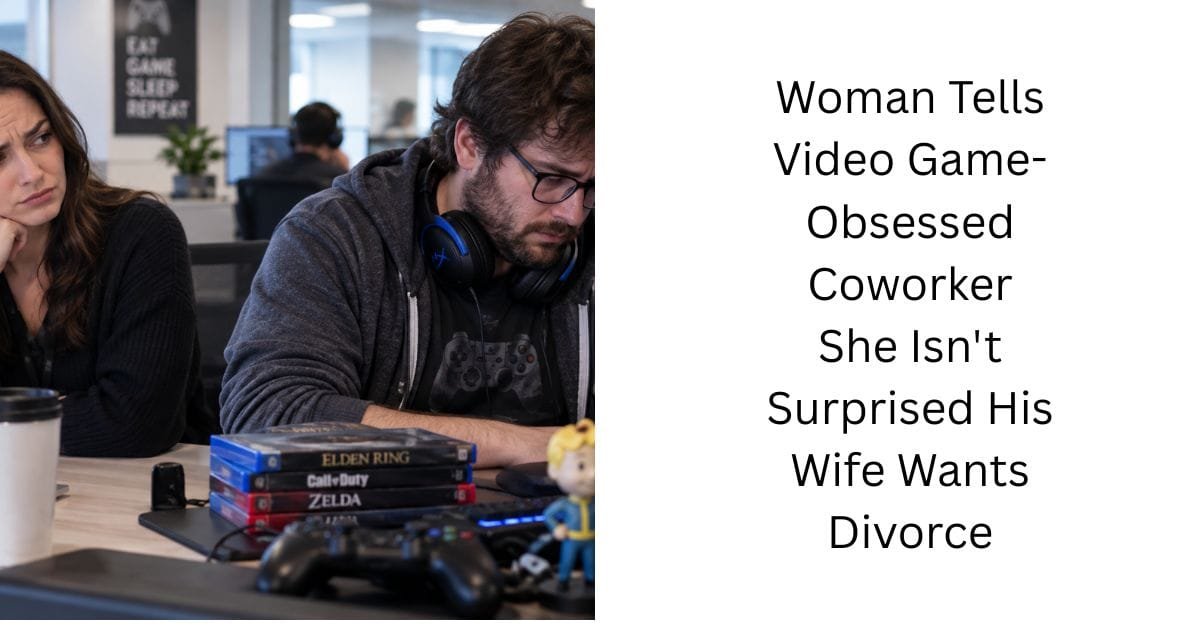
I never expected a casual conversation at work to turn into such an uncomfortable situation, but recently one of my coworkers started complaining to me about his marriage, and I eventually told him something he clearly didn’t want to hear. He is a nice enough person, and I have never had any serious problems with him professionally, but everyone at work knows that he is extremely obsessed with video games. He talks about gaming constantly, watches gaming streams during his breaks, and spends a huge amount of his free time playing. Normally, I wouldn’t care because people are allowed to have hobbies, and I certainly don’t think there is anything wrong with enjoying video games. The problem is that his gaming doesn’t seem to be just a hobby anymore. He talks about spending entire weekends playing, sometimes staying up most of the night, and frequently turning down plans because he wants to finish a game or participate in some online event. Recently, he started telling coworkers that his wife was unhappy with him and was talking seriously about divorce. When he eventually brought the subject up with me, I listened for a while, but I couldn’t honestly pretend I was surprised by what he was telling me.
According to him, his wife had been complaining for months that she felt ignored and unimportant. He said she wanted him to spend more time with her, help around the house, and participate in family activities instead of disappearing into his gaming setup every evening. He seemed genuinely confused by her frustration. He kept saying that he worked hard during the week and believed he deserved to relax when he came home. From his perspective, playing games was how he recovered from stress, and he didn’t understand why his wife couldn’t simply accept that. He told me that he still loved her and that he didn’t think his gaming should be a big enough problem to destroy a marriage. I asked him how much time he actually spent gaming each day, and his answer surprised me. On an average weekday, he said he could easily play for several hours after work, and on weekends he sometimes played most of the day. He admitted that his wife often ate dinner alone because he was in the middle of a game or talking to friends online. He also said there had been times when she asked him to stop playing so they could talk, but he told her he would be available after he finished his current match.
What really caught my attention was the way he described his wife’s attempts to communicate with him. He said she had repeatedly told him that she wasn’t necessarily asking him to give up gaming. She simply wanted balance. She wanted them to have dinner together, spend some evenings without screens, go out occasionally, and feel like they were actually a married couple rather than two people living in the same house. He admitted that she had even suggested creating a schedule where he could have dedicated gaming time while also setting aside time for their relationship. Instead of seeing that as a reasonable compromise, he apparently felt like she was trying to control his hobby. He told me that he didn’t understand why she couldn’t just sit nearby while he played or find something else to do. I asked him whether he ever planned activities himself or made an effort to spend quality time with her. He became quiet for a moment and admitted that most of their time together happened when she specifically asked him to do something. That was when I started to understand why his wife might be reaching her breaking point.
He also complained that his wife had recently stopped trying to get his attention. He said she no longer asked him to go places as often and had started spending more time with friends and family without him. He seemed hurt by this and interpreted it as proof that she was emotionally distancing herself from the marriage. I pointed out that perhaps she had simply become tired of asking for attention and being rejected. He didn’t like that explanation. He said that if she truly loved him, she should continue trying to make the relationship work. I asked him whether he had considered that she might have already spent months or years trying before reaching this point. He didn’t have much to say. Instead, he went back to talking about how much he loved gaming and how unfair it felt that his wife was making him choose between his hobby and his marriage. I told him that nobody was asking him to completely give up gaming. From everything he had described, his wife seemed to be asking him to make room for her in his life.
Eventually, he asked me directly whether I thought his wife was being unreasonable for considering divorce. I knew that whatever answer I gave could potentially make things awkward at work, but I also didn’t want to lie to him. I told him honestly that, based on everything he had told me, I wasn’t surprised she had reached that point. I explained that I wasn’t saying he was a terrible husband or that video games were inherently bad. The issue was that he seemed to be consistently prioritizing gaming over his relationship. If his wife repeatedly asked for time together and he repeatedly chose to continue playing, then eventually she was going to stop asking. I told him that a marriage can’t survive on love alone if one person constantly feels ignored. He looked genuinely offended and said that I didn’t know the full story. I reminded him that I was only responding to the story he had just told me. I wasn’t claiming to know every detail of their marriage, but based on his own description, I could understand why his wife was unhappy.
After our conversation, he became noticeably defensive around me. He told another coworker that I had judged him without knowing what he was going through. I felt bad about that because I never intended to embarrass him or turn his personal problems into workplace gossip. At the same time, I don’t regret being honest when he directly asked for my opinion. I think sometimes people tell stories about their relationships expecting everyone to automatically agree with them, and then become angry when someone points out the parts that don’t make them look good. He kept emphasizing that his wife wanted a divorce because she “hated gaming,” but when I asked questions, it became clear that the issue was much bigger than video games. She wanted attention, companionship, and shared responsibility. He wanted to spend his free time doing something he enjoyed. Neither of those needs is automatically wrong, but refusing to find a compromise can eventually destroy a relationship.
Now I’m wondering whether I should have kept my opinion to myself. I wasn’t trying to interfere in their marriage, and I certainly don’t want to be responsible for whatever happens between them. But when someone tells you that their spouse is considering divorce and then asks whether you think their spouse is being unreasonable, it’s difficult to pretend you don’t have an opinion. I still believe hobbies are important and that everyone deserves time for themselves, including married people. But there is a difference between having a hobby and allowing that hobby to consume so much of your life that your partner feels abandoned. If his wife has genuinely spent months asking him for more time and he has continued choosing video games, then I can understand why she might have finally reached her limit. I hope he takes a serious look at his priorities instead of simply blaming his wife. Maybe their marriage can still be saved if he is willing to make real changes, but if he expects her to accept being second place to a video game forever, then I honestly can’t say I’m surprised she is considering divorce.
Read Story…
“AITA for telling my coworker I’m not surprised his wife divorced him?”
The OP explained why her honest opinion did not sit well with one of her coworkers:
“I (20 F[emale]) was recently told by my coworker (40 M[ale]) that he and his wife (37 F[emale]) were getting divorced.”
“For context, they had just gotten married last year after dating his wife for 10 years.”
“I’ve worked at this job since I was 16, and this coworker has become my closest work friend, so I was the first to know of the engagement and now of the divorce.”
“We bonded over our shared love of video games (this is relevant, I swear).”
“We both played a lot of games and would talk about the ones we love the most.”
“In the time I’ve known him, he’s loved Final Fantasy 14, which is an online game you play with other people.”
“He talked about this game and the people he would hang out with in the game constantly, talking about the hours he spends playing it every day.”
“Shortly after he and his wife had gotten married, he started complaining about her and her neediness.”
“When I asked about it he would say she wanted him to spend time with her instead of playing video games.”
“I had told him at the time that he should be making time for his wife, but he ignored me.”
“Over the next year, he was constantly complaining about her and her ‘neediness’, and I would suggest taking some time off from his game to hang out with her, but my idea was always shut down.”
“Eventually, I got fed up with him and asked him to stop bringing it up with me, and he did for about 2 months.”
“That’s when he told me about her asking for a divorce.”
“I casually mentioned that I wasn’t surprised that she was divorcing him, seeing as he loved Final Fantasy more than her.”
“I didn’t really think before I spoke and just said what I had been thinking every time he brought up his relationship problems.”
“He was shocked at my response and seemed taken aback.”
“I continued saying all you ever talk about are video games, and everything you ever told me about your wife was negative.”
“He got very upset with me and complained about it to our other coworkers and our boss.”
“We work in a kitchen with only about 10 staff members, so it wasn’t too long before everybody knew about what I said.”
“Our boss stayed out of it, not seeing my comment as bad enough to warrant any kind of action.”
“Some of my coworkers around my age who also frequently talked with this coworker took my side while the older ones took his.”
“It has divided the kitchen staff and has made it uncomfortable to work with some of my coworkers who think I’m in the wrong.”
“So, AITAH for saying I wasn’t surprised about my coworkers divorce?”
Fellow Redditors weighed in on where they believed the OP fell in this particular situation, by declaring:
- NTA – Not The A**hole
- YTA – You’re The A**hole
- NAH – No A**holes Here
- ESH – Everyone Sucks Here
The Reddit community unanimously agreed that the OP was not the a**hole for telling their coworker she wasn’t surprised by his divorce:
Everyone agreed that as the OP’s wife made the reason why she finally left him crystal clear throughout their entire marriage, the OP’s declaration shouldn’t have come as a surprise either:
“NTA.”
“You nailed it.”
“The only mystery is why, after 10 years of dating, she didn’t realize his first love was FFXIV.”
“Isn’t the point of dating to learn things like that?”- ReadMeDrMemory
“NTA.”
“If you don’t want to hear your solicited opinions, don’t keep telling ppl your life story unsolicited.”-exaltedfemshep
“NTA.”
“Why is a 40-year-old dropping all his relationship drama on a 20-year-old?”
“Was he hoping to get with you if he complained enough?”
“And he’s been your closest friend at work since you were 16?”
“That’s just all kinds of ick.”
“He is 40 years old and acting like a petulant child and going to tell on you because he didn’t like what you said.”
“I’d limit all my interactions with him because he doesn’t take your advice and then narcs on you.”
“You told the truth – he was a shitty husband, and his wife left because she deserves better than someone who doesn’t meet her needs and complains about her.”
“Sounds like they dated for 10 years and she hoped marriage would cure him and make him a decent partner, and it didn’t.”
“OMG, how is this man 40 years old?”- Tofulish8889
“NTA.”
“He wants to drop his complaints on you, then thank you from all of us for telling Captain Clueless the obvious before he divorces and dates some other poor woman and whines again.”-julesk
“NTA.”
“He’s got a lot of growing up to do for a 40 y/o.”
“I agree with you, his wife was right to divorce him.”- whittydee
“NTA.”
“It was inappropriate of him to tell you about his marital problems in the first place.”
“He’s old enough to be your dad; he shouldn’t have been befriending a minor.”
“Buddy is terminally immature at best.”
“If you hadn’t been so blunt with him, I’d bet money on him trying to pursue you next because ‘you just understand him’.”- spaghettifiasco
“NTA.”
“This person is your closest work friend.”
“You showed him a mirror he didn’t like.”
“If he didn’t want your opinion, he should have kept to himself.”
“Your opinion could even help him introspect and change course with his wife, who knows him from 10yrs.”- LegInternal3417
“NTA!”
“The fact he can’t take any feedback is also a reason why he is probably getting divorced.”-Ruebee90
“NTA.”
“Clearly he needed to hear it!”- Runnrgirl
“Just because it hurts his feelings doesn’t make it untrue.”
“Truth hurts.”
“You didn’t say it with the intention to hurt him, I hope, maybe just explaining?”
“Maybe apologize for the bluntness of it, but truth is what it is.”
“If he didn’t want his relationship business out there, he should’ve stopped bringing it up.”
“To be fair, you already asked him to stop talking about it.”
“NTA.”- Professional-Tie3968
“NTA.”
“In the long run, you may have been the only person to be blunt enough to give him the cold, hard truth since he was so very clueless.”
“But there is a lesson for you here also in how close you can get to people at work and how it can affect your work life.”- BlewJeanBaby
“NTA.”
“From his reaction, he clearly just wanted a pity party and a fake reaction to why he’s getting a divorce.”
“You have warned him before, even given him sound advice.”
“It is a little weird that you are his closest friend.”
“The age difference is pretty significant, and you are/should be at different stages of life.”
“Be careful around this guy.”- Time-Outcome8599
“NTA, the thing is that this guy had probably heard from all his online friends how horrible she is, and that it’s her fault, etc, and so I think he needed someone in his life to lay out exactly what he did to cause this.”
“He might not learn from it still, but we can hope that he will at least.”- According_Ad6364
“NTA.”
“Real friends will tell you when you’re in the wrong.”- RandomNameRandomly
“NTA.”
“I had some friends who played FFXIV like a job during lockdown, and they really did ignore EVERYTHING else, and it sucked for everyone around them.”
“Sure, what you said wasn’t, like, kind or whatever but it wasn’t incorrect either.”- NightOwlEye
“NTA.”
“But the only reason I’m ruling that and not ESH is because that’s some sh*t I would say.”
“Probably not a good idea to say I told you so, but man sometimes people need to hear it.”- No-Bobcat9004
“NTA.”
“He was probably only offended because he knew that you were right.”- Own-Comparison-5856
It couldn’t have been easy for the OP’s colleague to hear that his love of video games cost him his marriage.
What’s more upsetting, however, is that he could have possibly been surprised by this, as his wife gave him fair warning that this was a possibility.
Hopefully a reality check for all of these coworkers’ future relationships…
but more likely leading to many solo nights alone playing Final Fantasy IV.
A Coworker’s Gaming Habit Raises Questions About His Marriage
I never expected a conversation with one of my coworkers to become this uncomfortable, especially because I wasn’t the person who started talking about his marriage. He came to me one afternoon and began complaining about problems at home. He said his wife had been talking about divorce, and he seemed genuinely shocked that their relationship had reached that point. I have always considered him a friendly coworker, so I listened without trying to judge him. However, there was one thing about his story that immediately stood out to me. He is absolutely obsessed with video games. Having a hobby isn’t unusual, and I don’t think there is anything wrong with adults enjoying games in their free time. The problem is that gaming seems to occupy an enormous amount of his life. He talks about games constantly, spends most of his evenings playing, and often chooses gaming over social activities. After hearing him explain what had been happening at home, I eventually told him that, based on what he had described, I wasn’t surprised his wife was considering divorce.

Advertisement
He initially started the conversation by telling me that his wife had “suddenly changed.” According to him, she used to be perfectly happy with their lifestyle and never complained about how much he played. He said she had recently become distant and had started criticizing his gaming more frequently. He couldn’t understand why something he had enjoyed for years had suddenly become a major problem. He told me that he worked hard, paid the bills, and believed he deserved to relax after work. In his mind, playing video games was no different from someone watching television, going to the gym, or spending time on another hobby. He seemed convinced that his wife was simply being unreasonable and trying to control how he spent his free time.
I asked him exactly how much time he spent gaming, because the amount of time can make a huge difference when talking about hobbies. He admitted that he usually played several hours every evening. On weekends, he sometimes started in the morning and continued until late afternoon or evening, with only short breaks. He said there were days when he barely left his gaming room. I asked whether his wife spent any of that time with him, and he said she sometimes sat nearby or watched television while he played. When I asked whether they regularly went out together or had evenings without gaming, he became less certain. It sounded like most of their shared time happened while he was doing something else.
He explained that his wife had been asking him to spend more time with her. She wanted them to have dinner together without him checking his game, go out on weekends, and occasionally have an evening where neither of them spent hours staring at a screen. According to him, she had told him several times that she wasn’t asking him to quit gaming. She simply wanted some balance. That distinction seemed important to me because he kept describing the situation as though his wife wanted to take away his favorite hobby. From what he was telling me, however, she didn’t seem to be asking for that at all. She appeared to be asking for a reasonable amount of attention from her husband.
He admitted that he sometimes ignored her when she asked him to stop playing. He said that if he was in the middle of an online match, he couldn’t simply walk away because other people were depending on him. He would tell her he would spend time with her afterward. The problem was that “afterward” often became much later than he originally promised. Sometimes he would finish one match and immediately start another. Other times he would tell himself he would play for another thirty minutes and end up playing for several more hours. He seemed to recognize that this happened but didn’t think it was a serious problem.
His wife apparently became frustrated with having to compete for his attention. She would make plans, ask him to go somewhere, or suggest doing something together, and he would often say he was busy with a game. Eventually, she started making plans without him. He complained that she had begun spending more time with her friends and family instead of staying home waiting for him. He said that this made him feel like she didn’t care about their marriage anymore. I pointed out that it was possible she had simply stopped waiting because she had become tired of being disappointed.
That comment didn’t go over particularly well. He told me that if she really loved him, she would understand that gaming was important to him. He said she knew who he was when they got married and that she shouldn’t suddenly expect him to change. I asked whether his gaming habits had always been this intense or whether they had increased over time. He admitted that he played much more now than he did when they first got together. He explained that he had more games available, better equipment, and more online friends. His work schedule also meant that gaming was one of the easiest ways for him to relax.
I asked him whether he and his wife had ever discussed how much time they would spend gaming after getting married. He said they hadn’t really needed to because it had never seemed like a problem. That made me think the situation had gradually changed. Sometimes a habit doesn’t seem problematic when you’re dating because you have separate homes, separate schedules, and fewer responsibilities. Once you share a household, however, the same habit can affect another person much more directly.
He told me that his wife had also complained about household responsibilities. Apparently, there were times when she would come home from work and start cooking, cleaning, or handling errands while he was already playing. He said he helped around the house but admitted that he wasn’t always aware of what needed to be done. If she asked him to help while he was gaming, he sometimes became irritated because he felt like she was interrupting his relaxation time. I asked him whether he thought she might also deserve uninterrupted relaxation time after work. He didn’t answer immediately.
This was when I realized that the problem probably wasn’t really video games. Gaming was simply the most visible symptom. His wife seemed to be feeling as though she was carrying more of the relationship and household responsibilities while he was spending his free time doing whatever he wanted. If that was the situation, I could understand why resentment had built up. A hobby becomes a serious relationship problem when one person gets hours of leisure while the other person is left handling everything else.
He insisted that he wasn’t intentionally neglecting his wife. He said he loved her and believed they had a good marriage despite their disagreements. He also said that he had never cheated on her and had never done anything he considered seriously wrong. I told him that relationships don’t always fall apart because of one dramatic betrayal. Sometimes they deteriorate because one person repeatedly feels ignored, unheard, or unimportant. He seemed surprised by that idea.
According to him, his wife had already tried talking to him several times. She had suggested setting specific gaming hours so he could still enjoy his hobby without it taking over the entire evening. She also suggested having certain nights where they spent time together without games. He said he thought the idea was unnecessary because he didn’t want his hobby to feel like something that required permission. I understood that he wanted freedom, but I also understood why his wife wanted some predictable time with her husband.
He told me that recently his wife had stopped arguing about gaming altogether. Instead, she had become quieter and more independent. She stopped asking him to come to bed at the same time, stopped reminding him about plans, and stopped trying to convince him to spend time together. He interpreted this as her giving up on the relationship. I told him that sometimes people become quiet after they have spent a long time asking for the same thing without seeing any change.
He didn’t like hearing that. He said it sounded as though I was blaming him for everything. I explained that I wasn’t claiming to know the entire story of their marriage. I was only responding to the information he had given me. If his wife had repeatedly asked for more quality time and he repeatedly prioritized gaming, then it wasn’t unreasonable for her to feel neglected. He argued that she could have simply joined him while he played. I asked whether he ever considered doing something she enjoyed instead. Again, he didn’t have a clear answer.
Eventually, he asked me directly whether I thought his wife was justified in considering divorce. I hesitated because he is my coworker, and I didn’t want to become involved in his personal life. But he had asked me for my honest opinion, so I gave it to him. I told him that based on everything he had told me, I wasn’t surprised that she had reached that point. I wasn’t saying divorce was necessarily the only solution, but I could understand why she might feel exhausted.
He looked genuinely offended. He said that he couldn’t believe I would take his wife’s side after hearing how much he loved her. I told him that loving someone doesn’t automatically mean you’re meeting their needs. A person can genuinely love their spouse while still behaving in ways that make the relationship difficult or unhealthy. I also reminded him that I wasn’t saying he was a bad person. I was saying that his actions, as he described them, were having consequences.
He then argued that everyone needs an escape and that gaming was his way of dealing with stress. I agreed with him. I told him that having time to himself was completely reasonable. The problem was balance. If he worked all day and wanted to spend an hour or two gaming, that was one thing. If he routinely spent most of his free time gaming while his wife handled household responsibilities and repeatedly asked for more connection, that was something else entirely.
He told me that his wife should have understood that gaming was part of who he was. I responded that marriage also becomes part of who you are. Once you choose to share your life with someone, you have responsibilities toward that relationship. That doesn’t mean giving up every hobby or becoming available every second of the day. It means recognizing that your choices affect another person and being willing to make compromises.
After our conversation, I noticed that he became more distant from me at work. He stopped casually talking to me and seemed irritated whenever we were around each other. Later, another coworker mentioned that he had complained about me judging his marriage. I felt uncomfortable because I never intended for our conversation to become workplace gossip. I had only answered a question he specifically asked me.
Still, I don’t completely regret what I said. I think sometimes people tell a story expecting sympathy but accidentally reveal why the other person is unhappy. My coworker kept describing his wife as unreasonable, but the more details he gave, the more understandable her frustration became. She wasn’t apparently demanding that he never play games again. She wanted time with her husband, help with their shared responsibilities, and some evidence that their relationship mattered to him.
I also think he may have misunderstood what his wife was actually saying. When someone repeatedly complains about a hobby, the natural reaction is to defend the hobby. But sometimes the hobby isn’t the real issue. The real issue is what the hobby represents. In this case, his gaming seemed to represent all the time and attention he wasn’t giving his wife. She wasn’t necessarily fighting against video games. She was fighting against feeling like they always came second.
I told him that if he genuinely wanted to save his marriage, he needed to stop focusing on whether his wife was “allowed” to dislike his gaming and start listening to what she was actually asking for. He could still play games, but he might need to create boundaries around his gaming time. He might need to take more responsibility around the house, make plans with his wife, and occasionally choose the relationship over the game. None of that seemed unreasonable to me.
I don’t know what ultimately happens between them. Maybe his wife will decide not to go through with the divorce if he makes meaningful changes. Maybe they have already reached a point where too much resentment has built up. I honestly don’t know because I only know his side of the story. What I do know is that I wasn’t surprised when he told me she was considering leaving. If a person repeatedly tells their partner, “I need more of you,” and the response is always, “My game is more important right now,” eventually they may stop asking altogether.
I still believe my coworker is capable of being a good husband, but being a good partner requires more than simply loving someone. It requires attention, communication, compromise, and the willingness to notice when your behavior is hurting the person you claim to care about. Video games themselves aren’t the enemy, and I would never tell someone they aren’t allowed to have hobbies. But if a hobby consistently takes priority over a marriage, then the hobby may eventually become part of the reason the marriage ends. That’s why, when he asked me whether I was surprised his wife wanted a divorce, I honestly couldn’t say I was.